
 Victoria
BuyerRank is reader-supported. We may earn a commission when you buy through links on this page, at no extra cost to you. As an Amazon Associate, we earn from qualifying purchases. Prices and availability are accurate as of the date of publication and can change at any time — please check the retailer for the current price. Learn more. Written by Victoria — how we choose what to recommend.
Our quick picks
Ranked by what each one is best at, not by a score we made up. Ratings are what the product showed on Amazon when we last checked — how we rank.
- The one we would put in a kitchen or a finished basement without thinking twice.
- 3.2 cubic feet is the size most people actually need: roughly 130 cans or 26 bottles, in a footprint that slides into the gap where a trash can used to live.
- The one to get if lukewarm-ish soda is a dealbreaker.
- This is the same class of fridge as our top pick but with a meaningfully colder floor: 32 F instead of 40 F.
- A genuine commercial unit – enormous capacity, and it looks the part.
- If you host regularly, or you are stocking a game room, this removes the problem of restocking mid-party.
- Two independent zones, so wine and cans stop fighting over one temperature.
- The dual-zone layout is the honest answer to the compromise every single-zone fridge forces: 19 bottles in one compartment at wine temperature, 57 cans in the other at drinking temperature.
- Bar-height, three doors, and it holds close to 500 cans.
- This is a back bar cooler – the unit you stand behind, not the one you put in a kitchen.
- Dual zone and front-venting, without commercial pricing.
- 5.3 cubic feet split between 21 bottles and 88 cans, with automatic defrost and a lock, in a 24-inch built-in format.
- The size step most people should be looking at and are not.
- 4.5 cubic feet holds 37 bottles or 145 cans – about 40% more than the common 3.2 cu ft models, in a cabinet only a few inches taller.
- Nothing clever, nothing to go wrong.
- Around 120 cans, precise temperature control, automatic defrost, adjustable shelves and a stainless finish.
- A proper built-in with a lock, which is a shorter list than you would think.
- 5.3 cubic feet, a 37-65 F digital range, and a lockable glass door in a front-vent 24-inch chassis.
- The lowest-commitment way to find out whether you actually want one.
- Around 95 cans, a quiet compressor, adjustable temperature and removable shelves.
Below you get the reasoning, the specifications worth comparing, and the limitations we found.
A beverage fridge is one of those purchases where every listing photo looks identical and every product is rated 4.5 stars. The difference shows up three months later — when the compressor in the cheap one is loud enough to hear from the next room, or the shelves turn out to be half an inch too short for the bottles you actually buy.
The specifications that decide whether you are happy with yours are narrower than the marketing suggests: how cold it actually goes, whether it vents from the front or the back, and whether the shelves move. We went through the current field and picked ten models, each for a different situation — a small apartment, a built-in kitchen gap, a garage bar that needs to hold 400 cans.
A note on method: we have not run these units in our own homes. Our picks are based on manufacturer specifications, the physical constraints of each design, and patterns across long-term owner reviews. Where a specification is a manufacturer claim rather than a measured result, we say so.
How this list was made
We started with every current beverage fridge from established brands and removed anything discontinued, sold without a clear warranty, or using thermoelectric cooling rather than a compressor — thermoelectric units cannot hold temperature in a room above about 77°F, which rules them out for garages and most kitchens in summer.
What was left, we sorted on four things:
- Actual temperature floor. A fridge that stops at 40°F is a wine fridge with a marketing problem. One that reaches 32°F is a drinks fridge.
- Venting direction. Front-vent units can be built into cabinetry. Rear-vent units cannot, no matter what the listing implies.
- Shelf adjustability. Fixed shelves decide for you what fits. Adjustable ones do not.
- Realistic capacity. Can counts assume standard 12oz cans packed perfectly. We treat them as an upper bound, not a promise.
Then we assigned each remaining model a role, rather than ranking them one to ten. A fridge that is wrong for your kitchen is not a worse fridge — it is a fridge for a different room.
Quick comparison

Antarctic Star 3.2 Cu.Ft Beverage Refrigerator
3.2 cu.ft fridge holds 26 bottles or 130 cans, with adjustable 40°F–61°F cooling, quiet compressor, LED lighting, glass door, and adjustable shelves for stylish, flexible storage

EUHOMY 3.2 Cu.Ft Beverage Refrigerator
Compact 3.2 cu.ft fridge holds up to 130 cans with precise 32–61°F touch control. Features 360° air cooling, tempered glass door, quiet 36dB compressor, 4 adjustable shelves, reversible door, and energy-efficient design for home, office, or bar

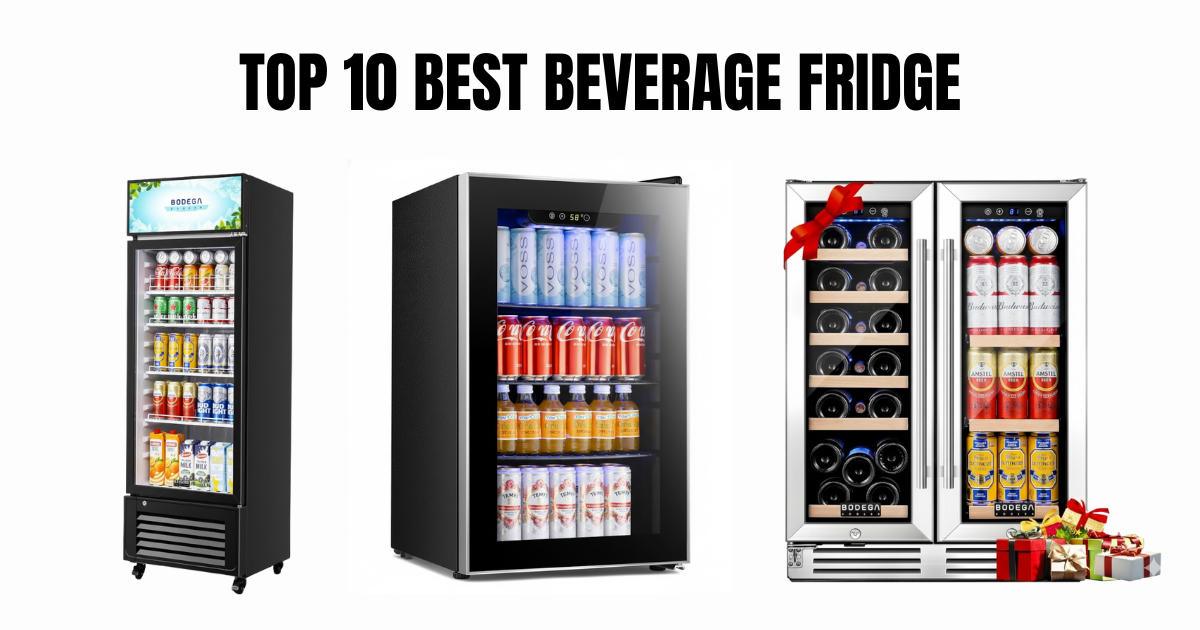
BODEGACOOLER 10 Cu.Ft Commercial Beverage Display Refrigerator
Holds 240 cans or 120 bottles, with bright LED lighting, 4 adjustable shelves, mechanical temp control, energy-saving compressor, automatic defrost, and magnetic door for perfect sealing — ideal for bars, stores, or restaurants

BODEGA 24″ Dual Zone Wine & Beverage Refrigerator
Holds 19 bottles and 57 cans, dual-zone cooling, quiet 42dB, double glass doors, LED control, safety lock, and front-vent design for built-in or freestanding use

Mikibama 53″ 3-Door Back Bar Beverage Refrigerator
Spacious 11.3 cu.ft cooler holds up to 480 cans with 3 glass doors, digital temperature control, and LED lighting. Features quiet, energy-efficient cooling, durable build, and sleek design — perfect for bars, restaurants, or home use

EUHOMY 24″ Dual Zone Wine & Beverage Refrigerator
5.3 cu.ft dual-zone fridge holds 21 bottles and 88 cans with digital control, quiet cooling, LED light, auto defrost, lock, and front vent for built-in or freestanding useProduct Features

COWSAR 4.5 Cu.Ft Wine & Beverage Refrigerator
4.5 cu.ft fridge holds 37 bottles or 145 cans with quiet cooling, double glass door, LED light, adjustable shelves, and airtight seal — perfect for home bars or kitchens

hOmeLabs 3.2 Cu.Ft Beverage Refrigerator
Holds up to 120 cans with precise temperature control, efficient cooling, automatic defrost, and adjustable shelves in a sleek stainless steel design — perfect for home, office, or bar use

EUHOMY 24″ Built-In Beverage Refrigerator
5.3 cu.ft capacity with adjustable shelves, digital temp control (37–65°F), quiet energy-efficient cooling, blue LED light, lockable glass door, and front-vent design for undercounter or bar use

Antarctic Star 95 Can Beverage Refrigerator
Quiet compressor minimizes noise, adjustable temperature fits any drink type, and removable shelves offer flexible storage.
The 10 Best Beverage Fridges, Reviewed
1. Antarctic Star 3.2 Cu. Ft. Beverage Refrigerator — Best Overall
The one we would put in a kitchen or a finished basement without thinking twice.
3.2 cubic feet is the size most people actually need: roughly 130 cans or 26 bottles, in a footprint that slides into the gap where a trash can used to live. The 40–61°F range is wide enough to hold soda properly cold at one end and red wine at the other, and the shelves adjust rather than sitting in fixed slots, which is what decides whether tall bottles fit.
What we like
- Temperature range covers cans and wine, so you are not locked into one use
- Adjustable shelves, not fixed racks — tall bottles fit
- Footprint fits most kitchen gaps and under most bar counters
- Glass door and interior lighting make it usable as a display piece
The part that annoys people
- 40°F is the coldest it goes, which is not ice-cold if that is what you want
- Freestanding design — it vents from the back, so it should not be enclosed in cabinetry
- A glass door in direct sunlight will make the compressor work noticeably harder
Right for: most households wanting one fridge to handle both drinks and a few bottles of wine. Skip it if: you need built-in installation or sub-40°F cans.
Check the current price on Amazon →
2. EUHOMY 3.2 Cu. Ft. Beverage Refrigerator — Best for Ice-Cold Cans
The one to get if lukewarm-ish soda is a dealbreaker.
This is the same class of fridge as our top pick but with a meaningfully colder floor: 32°F instead of 40°F. That difference matters if you are storing cans rather than wine. It is also the quietest unit in this group on paper at 36dB, and the 360° air circulation design means the cans at the back get as cold as the ones at the front — a common complaint with cheaper models.
What we like
- 32°F floor — cold cans, not just cool ones
- 36dB rated, quiet enough for an open-plan room
- 360° circulation avoids warm spots at the back
- Reversible door, so it works in either corner of a room
Where it disappoints
- 32°F is too cold for most wine, so it is a drinks fridge first
- 36dB is a rated figure measured in a lab; a compressor cycling on at night is still audible in a bedroom
- Touch controls are easier to knock than physical dials
Right for: soda, beer and seltzer drinkers. Skip it if: this is primarily a wine fridge.
Check the current price on Amazon →
3. BODEGACOOLER 10 Cu. Ft. Commercial Beverage Display Refrigerator — Best for Entertaining
A genuine commercial unit — enormous capacity, and it looks the part.
At 240 cans or 120 bottles this is four or five times the capacity of a standard under-counter fridge, with automatic defrost and a magnetic door seal that holds temperature far better than a friction seal. If you host regularly, or you are stocking a game room, this removes the problem of restocking mid-party.
What we like
- 240-can capacity — truly no restocking during an event
- Automatic defrost, so you are not scraping ice off the back panel
- Magnetic door seal holds temperature better than budget seals
- Four adjustable shelves handle mixed can and bottle loads
The drawbacks
- This is commercial equipment: it is large, heavy, and it looks like shop furniture in a living room
- Running costs are higher than a small fridge — it is cooling a lot of empty air most of the time
- Mechanical temperature control is less precise than a digital thermostat
- You need to plan delivery and placement before buying, not after
Right for: garages, game rooms, home bars and regular entertainers. Skip it if: it is going in a kitchen or an apartment.
Check the current price on Amazon →
4. BODEGA 24″ Dual Zone Wine & Beverage Refrigerator — Best Dual Zone
Two independent zones, so wine and cans stop fighting over one temperature.
The dual-zone layout is the honest answer to the compromise every single-zone fridge forces: 19 bottles in one compartment at wine temperature, 57 cans in the other at drinking temperature. The front-vent design is the part that matters structurally — it means this can sit inside cabinetry instead of standing free.
What we like
- Two independent zones — no compromise temperature
- Front vent, so it can be built into a cabinet run
- 42dB rating is reasonable for a dual-compressor design
- Safety lock, which is worth having if children are around
The catch
- Splitting the interior means less total capacity than a single-zone unit of the same size
- Dual zones give you two things to go wrong instead of one
- Built-in installation needs a correctly sized cabinet opening — measure before ordering
- More expensive than a single-zone fridge of the same exterior size
Right for: anyone storing wine and cans together in a kitchen. Skip it if: you only drink one or the other.
Check the current price on Amazon →
5. Mikibama 53″ 3-Door Back Bar Beverage Refrigerator — Best for a Home Bar
Bar-height, three doors, and it holds close to 500 cans.
This is a back bar cooler — the unit you stand behind, not the one you put in a kitchen. At 11.3 cubic feet and up to 480 cans across three glass doors, it is built for a bar counter or a garage refrigeration setup, with digital temperature control and LED lighting for display.
What we like
- Up to 480 cans across three separate doors
- Bar-height format designed to sit under a counter run
- Digital control is more precise than the mechanical dials on most commercial units
- Opening one door at a time limits how much cold air you lose
Where it falls short
- 53 inches wide — this needs dedicated space planned in advance
- Commercial styling that will look out of place outside a bar or garage
- Three glass doors mean three seals to keep clean and check
- Significant electricity draw compared with a domestic unit
Right for: home bars, finished garages and basements. Skip it if: you are furnishing a normal kitchen.
Check the current price on Amazon →
6. EUHOMY 24″ Dual Zone Wine & Beverage Refrigerator — Best Built-In Value
Dual zone and front-venting, without commercial pricing.
5.3 cubic feet split between 21 bottles and 88 cans, with automatic defrost and a lock, in a 24-inch built-in format. The auto defrost is the feature worth paying attention to here: on manual-defrost units, ice build-up on the rear wall slowly eats your usable space and nobody remembers to deal with it.
What we like
- Auto defrost — no periodic emptying and thawing
- Front vent for built-in installation
- Dual zone at a lower price than most 24-inch units
- Lockable, useful in a shared or rental space
What owners complain about
- 5.3 cu ft split two ways is not much per zone
- 24-inch built-ins are unforgiving about cabinet opening dimensions
- Digital control panels on this class of unit are the most common failure point
- Freestanding use is possible but wastes the front-vent design
Right for: kitchen renovations with a 24-inch gap to fill. Skip it if: you want maximum capacity per dollar.
Check the current price on Amazon →
7. COWSAR 4.5 Cu. Ft. Wine & Beverage Refrigerator — Best Mid-Size Capacity
The size step most people should be looking at and are not.
4.5 cubic feet holds 37 bottles or 145 cans — about 40% more than the common 3.2 cu ft models, in a cabinet only a few inches taller. The double glass door and airtight seal are what hold temperature stable when the fridge is opened repeatedly, which is exactly what happens at a home bar.
What we like
- Noticeably more capacity than the standard 3.2 cu ft size for a small size increase
- Airtight seal recovers temperature faster after the door is opened
- Adjustable shelves for mixed bottle and can loads
- Double glass door construction reduces condensation
The downside
- Taller and heavier than a standard under-counter unit — check the height of your gap
- Freestanding design, so it needs clearance at the back
- Glass doors show fingerprints constantly
- No dual zone, so wine and cans share one temperature
Right for: home bars and households that keep running out of space. Skip it if: your gap is a strict under-counter height.
Check the current price on Amazon →
8. hOmeLabs 3.2 Cu. Ft. Beverage Refrigerator — Best Simple Pick
Nothing clever, nothing to go wrong.
Around 120 cans, precise temperature control, automatic defrost, adjustable shelves and a stainless finish. There is no dual zone, no lock and no app — and for an office, a den or a spare room, that is the point. Fewer features is fewer things that break in year three.
What we like
- Straightforward design with few failure points
- Auto defrost, which is not a given at this size
- Stainless finish suits an office or a den better than black plastic
- Adjustable shelves despite the simple specification
What you give up
- No dual zone and no lock
- Single temperature setting means a compromise if you store wine
- Stainless shows every fingerprint in a busy room
- Fewer features than similarly sized competitors, which matters if you want them
Right for: offices, dens, spare rooms and anyone who dislikes touchscreens. Skip it if: you want dual zone or a lock.
Check the current price on Amazon →
9. EUHOMY 24″ Built-In Beverage Refrigerator — Best Lockable Built-In
A proper built-in with a lock, which is a shorter list than you would think.
5.3 cubic feet, a 37–65°F digital range, and a lockable glass door in a front-vent 24-inch chassis. The wide temperature range makes it flexible — cold enough for beer at the bottom, warm enough for red wine at the top — and the lock matters in rentals, shared houses and homes with teenagers.
What we like
- 37–65°F range covers almost every drink
- Lockable, in a true built-in format
- Front vent for cabinet installation
- Blue LED lighting is useful in a dark bar area
The part that annoys people
- Single zone, so the wide range is one setting at a time, not two
- Built-in installation is unforgiving about cabinet dimensions
- Locks on glass doors deter, they do not secure
- Front-vent units run slightly louder than rear-vent designs
Right for: shared houses, rentals, and kitchens needing a lockable 24-inch unit. Skip it if: you need two zones at once.
Check the current price on Amazon →
10. Antarctic Star 95 Can Beverage Refrigerator — Best Affordable
The lowest-commitment way to find out whether you actually want one.
Around 95 cans, a quiet compressor, adjustable temperature and removable shelves. It is the smallest unit here and the least expensive, and it does the core job: cold drinks, visible, in a small footprint. If you are not sure a beverage fridge will earn its space, start here rather than with a commercial cooler.
What we like
- Smallest footprint in this group — fits where the others will not
- Compressor cooling rather than thermoelectric, so it holds temperature in a warm room
- Removable shelves let you fit odd-sized bottles
- Low-commitment way to test whether you will use one
Where it disappoints
- 95 cans goes quickly if you entertain
- Basic controls with no digital readout
- No lock, no dual zone, no auto defrost
- Thin shelving compared with larger units — do not overload it
Right for: apartments, dorms, offices and first-time buyers. Skip it if: you host more than occasionally.
Check the current price on Amazon →
How to Choose a Beverage Fridge
Start with where it is going, not what it holds
This is the step people skip. Measure the gap — width, depth and height — before looking at a single product. Then decide whether the unit will be standing free or sitting inside cabinetry, because that single decision eliminates most of the market. A rear-vent fridge enclosed in a cabinet cannot dump its heat, runs constantly, and fails early. Only a front-vent model can be built in.
Work out whether you are cooling cans or wine
Cans want roughly 35–38°F. Red wine wants roughly 55–65°F. A single-zone fridge cannot do both, and setting it to the middle does neither well. If you need both, that is what dual zone is for — and you accept less total capacity in exchange. If you mostly drink one, a single zone at the right temperature beats a dual zone at the wrong one.
Treat the can count as a ceiling
Manufacturer can counts assume standard 12oz cans stacked with no wasted space. Tall cans, bottles, odd shapes and the way people actually load a fridge will cut that figure substantially. If you need 100 cans of real-world capacity, look at units rated for 130 or more.
Noise is about placement, not just the dB figure
A 36dB rating sounds impressively quiet on paper. That figure is measured in controlled conditions, and it describes steady running, not the compressor kicking in at 2am. In a kitchen, none of this matters. In a bedroom, a studio apartment or an open-plan living room, it matters a great deal — and no beverage fridge is truly silent.
Glass doors have a cost
A glass door is the reason to buy one of these instead of a mini fridge, but it is a worse insulator than a solid door. Put one in direct sunlight or a hot conservatory and the compressor runs longer, the electricity bill goes up, and the unit wears faster. Tinted or double-glazed doors help; placement helps more.
Easy mistakes to make
- Buying on can count alone. The number on the box is an upper bound under ideal packing.
- Building in a freestanding unit. The most common and most expensive mistake in this category.
- Ignoring door swing. A door that opens into a walkway or against a wall makes the fridge annoying to use every single day. Check whether the door is reversible.
- Overloading thin shelves. Shelves in budget units have real weight limits, and bottles are heavy.
- Assuming quiet means silent. Compressor fridges cycle. Plan placement around that.
Frequently Asked Questions
Can a beverage fridge be used for wine?
Yes, but only if its temperature range reaches into the 50s and 60s°F. Many drinks fridges stop at 40–45°F, which is too cold for red wine and will dull the flavor of most whites. Check the stated range before assuming it will do both jobs.
Do beverage fridges need to be plumbed in or vented outside?
No. They plug into a standard outlet and vent into the room. What they do need is clearance in the right direction — rear-vent models need space behind, front-vent models can sit flush inside cabinetry.
How long does one take to get cold?
Plan on several hours from first plugging in to a stable temperature, and longer if you fill it immediately with room-temperature drinks. Let it run empty first if you can, then load it.
Is a compressor or thermoelectric model better?
Compressor, in almost every case. Thermoelectric units are quieter and cheaper but can typically only cool to around 20°F below the surrounding room, which fails in a warm kitchen or a garage in summer. Every model on this list uses a compressor.
Can a beverage fridge go in a garage?
Some can, some cannot. Garages swing between temperature extremes, and a unit not rated for that range may fail to hold temperature in summer or stop running in winter. Check for a stated ambient temperature range before putting one in an unheated space.
How much electricity does one use?
Less than a full-size refrigerator, but more than most people expect, and a glass door in a warm room increases it. Larger commercial-style coolers cost meaningfully more to run than compact units because they are cooling far more empty air.
Do the shelves really matter that much?
More than almost any other feature. Fixed shelves decide the maximum bottle height for you, permanently. Adjustable and removable shelves are what let one fridge handle cans one week and tall bottles the next.
What we would buy
For most households, the Antarctic Star 3.2 Cu. Ft. is the sensible default: the right size for a kitchen gap, a temperature range that covers both cans and wine, and shelves that move. If cold cans are the whole point, the EUHOMY 3.2 Cu. Ft. reaches 32°F where most stop at 40°F.
If the fridge is going into a cabinet run, you are choosing between front-vent 24-inch models — the BODEGA Dual Zone if you need wine and cans held separately, the EUHOMY 24″ Built-In if you want a lock and one wide temperature range instead. And if this is a garage bar rather than a kitchen, stop looking at domestic units entirely: the Mikibama 53″ back bar cooler and the BODEGACOOLER 10 cu ft are built for that job.
Whichever you choose, measure the space first and check venting direction second. Those two things cause more returns in this category than every other specification combined.
Prices and availability on Amazon change frequently — check the product page for current information before buying.
Also worth reading: our guide to the best wine coolers.