
 Victoria
BuyerRank is reader-supported. We may earn a commission when you buy through links on this page, at no extra cost to you. As an Amazon Associate, we earn from qualifying purchases. Prices and availability are accurate as of the date of publication and can change at any time — please check the retailer for the current price. Learn more. Written by Victoria — how we choose what to recommend.
Our quick picks
Ranked by what each one is best at, not by a score we made up. Ratings are what the product showed on Amazon when we last checked — how we rank.
- The size most people actually need, with a removable basket that makes it usable.
- The removable basket is what stops a chest freezer becoming an archaeological dig – without one, everything ends up at the bottom.
- R600a refrigerant and a seven-level thermostat – cheaper to run than it looks.
- R600a is a more efficient refrigerant than older alternatives, and a seven-level thermostat gives finer control than the three-position dials on budget units.
- Double the capacity, from a brand with a service network.
- Seven cubic feet is roughly a full bulk meat order plus a season of frozen vegetables.
- Ten cubic feet – for hunting, farming, and large households.
- At this size you are storing a side of beef, a hunting season, or a household’s worth of home-grown produce.
- Large, simple, and built around mechanical controls that keep working.
- Nearly nine cubic feet with two removable baskets and mechanical temperature control.
- The cheapest compact chest freezer here that still has a proper thermostat.
- R600a refrigerant, a seven-level thermostat, a removable basket and quiet operation – the same feature list as more expensive compact freezers, at a lower price.
- Switches between fridge and freezer – and it is enormous.
- Twenty-one cubic feet with adjustable shelves, drawers and LED lighting, convertible between refrigeration and freezing.
- Two baskets in a compact chest, running quietly.
- Most 3.5 cu ft freezers include one basket.
- Under 40dB – quiet enough for a kitchen or a hallway.
- A freezer running below 40dB is really unobtrusive, which matters if it is going anywhere near a living space.
- Electronic control from -12 F to 50 F – freezer or fridge as needed.
- A range from -12 F to 50 F means this can run as a deep freezer or as refrigeration, controlled electronically rather than by a numbered dial.
Below: why each one made the list, the numbers worth comparing, and what is wrong with it.
A chest freezer holds substantially more per cubic foot than an upright, costs less to run, and keeps food frozen far longer during a power cut because cold air does not fall out when you open the lid. Those three facts are why the format still exists in a world of frost-free uprights.
The trade-off is organization. Without baskets, a chest freezer becomes a well of unidentifiable frozen parcels, and the thing you want is always at the bottom. Almost every complaint about chest freezers traces back to this, and it is solved by baskets, labeling, and not buying more capacity than you will keep organized.
A note on method: we have not run these freezers ourselves. Our picks are based on manufacturer specifications, refrigerant and control type, and patterns across owner reports. Always check the stated ambient temperature range before placing a freezer in a garage or unheated space.
What we looked at
We sorted on the specifications that determine how a chest freezer lives with you:
- Baskets. The single feature that decides whether the freezer is usable or a pit.
- Thermostat granularity. A seven-level thermostat or electronic control beats a three-position dial.
- Defrost drain. Manual defrosting is inevitable; a drain plug makes it an hour rather than an afternoon.
- Ambient temperature rating. The specification that decides whether it can go in a garage.
Each freezer gets a role rather than a rank, because a 3.5 cu ft kitchen freezer and a 21 cu ft convertible are not the same purchase.
Quick comparison

Igloo 3.5 Cu. Ft. Chest Freezer with Removable Basket, Black
Igloo 3.5 Cu.Ft Chest Freezer – Compact freezer with quick freezing system, adjustable thermostat (-10°F to 10°F), removable wire basket for easy organization, and balanced hinge door for hands-free use

EUHOMY 3.5 Cu.Ft Chest Freezer with Removable Basket – Black
3.5 cu.ft capacity, compact design, energy-saving R600a compressor, 7-level thermostat, removable basket, quiet 38dB operation, easy-drain port, hover door for hands-free use

FRIGIDAIRE EFRF7003-BLACK 7 Cu.Ft Chest Freezer
7 cu.ft capacity, adjustable thermostat, removable basket, easy defrost drain, power indicator, durable aluminum interior

Hamilton Beach HBFRF1006 Chest Freezer, 10 Cu.Ft – White
Hamilton Beach HBFRF1006 10 Cu.Ft Chest Freezer – Large capacity, adjustable thermostat, removable basket, easy defrost drain, power indicator, and adjustable legs for stability

BLACK+DECKER 8.9 Cu.Ft Chest Freezer – White
BLACK+DECKER 8.9 Cu.Ft Chest Freezer – Large capacity, 2 removable baskets, mechanical temperature control with indicator lights, manual defrost with easy drain, perfect for home or garage storage

COSTWAY 3.5 Cu.Ft Chest Freezer – White
Energy-saving R600a compressor, 7-level thermostat, removable basket, quiet operation, easy-clean drain, and rolling casters for mobility

KoolMore CUFR-21C 21 Cu.Ft Convertible Freezer
2-in-1 fridge or freezer, large capacity, adjustable shelves and drawers, energy-efficient, LED lighting, and easy mobility with wheels

Kismile 3.5 Cu.Ft Chest Freezer
Compact, energy-saving design with 7-level thermostat, quiet compressor, 2 removable baskets, hinged door, and adjustable legs

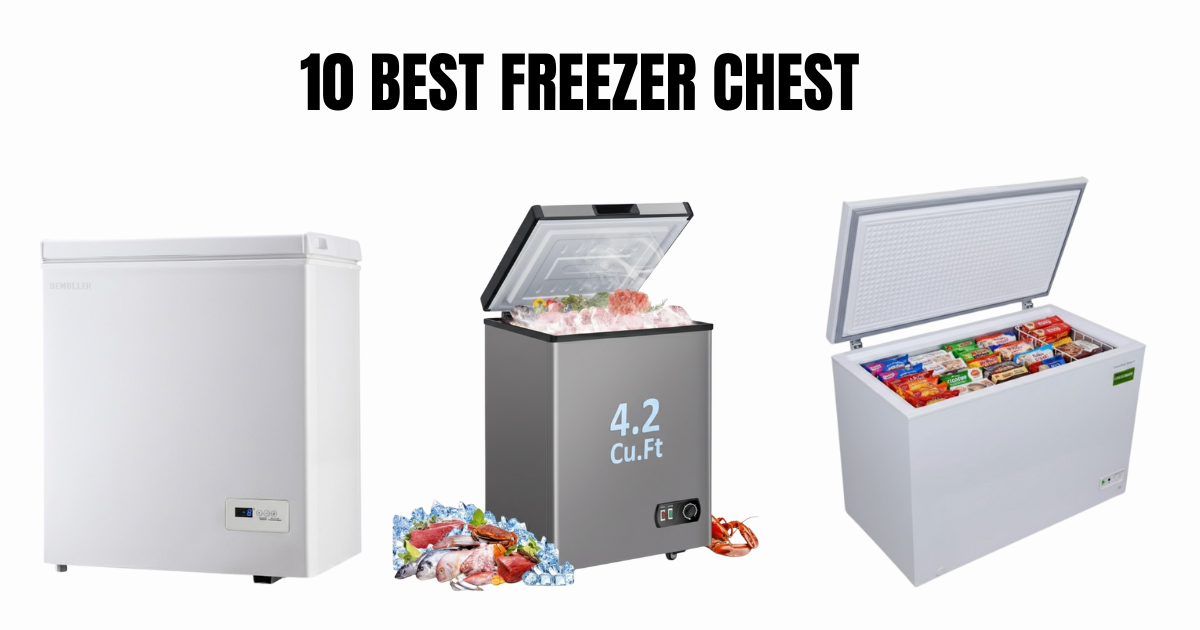
LifePlus 4.2 Cu.Ft Chest Freezer with Removable Basket – Gray
LifePlus 4.2 Cu.Ft Chest Freezer – 7-level thermostat, energy-saving, ultra-quiet under 40dB, stain-resistant interior, removable basket, and wheels for easy mobility

DEMULLER 4.0 Cu.Ft Chest Freezer
Precise electronic temperature control (-12°F to 50°F), efficient cooling, 2 removable baskets, hands-free door, and adjustable feet for stability
The 10 Best Chest Freezers, Reviewed
1. Igloo 3.5 Cu. Ft. Chest Freezer — Best Small Chest Freezer
The size most people actually need, with a removable basket that makes it usable.
3.5 cubic feet is the sweet spot for a household adding freezer capacity rather than replacing it: enough for a bulk meat purchase or a season of garden produce, small enough to fit in a utility room or under a workbench. The removable basket is what stops a chest freezer becoming an archaeological dig — without one, everything ends up at the bottom.
What we like
- 3.5 cu ft fits most spare corners and utility rooms
- Removable basket keeps frequently used items reachable
- Adjustable thermostat rather than a fixed setting
- Quick-freeze function for fresh loading
Where it falls short
- Manual defrost, as with almost all chest freezers
- Chest design means digging for items at the bottom
- No interior light on most units this size
- Check the ambient temperature rating before putting it in a garage
Right for: adding capacity in a house or flat. Skip it if: you want items visible and reachable.
Check the current price on Amazon →
2. EUHOMY 3.5 Cu. Ft. Chest Freezer — Best Efficiency
R600a refrigerant and a seven-level thermostat — cheaper to run than it looks.
R600a is a more efficient refrigerant than older alternatives, and a seven-level thermostat gives finer control than the three-position dials on budget units. A freezer runs continuously for years, so the efficiency difference compounds into real money in a way that the purchase price comparison hides.
What we like
- R600a compressor is efficient and inexpensive to run
- Seven thermostat levels for precise control
- Removable basket included
- Quiet operation for a compressor freezer
What owners complain about
- Manual defrost required periodically
- Small capacity limits bulk buying
- No interior lighting
- Chest format makes organization harder than upright
Right for: long-term running cost. Skip it if: you need large capacity.
Check the current price on Amazon →
3. FRIGIDAIRE EFRF7003 7 Cu. Ft. Chest Freezer — Best Mid-Size
Double the capacity, from a brand with a service network.
Seven cubic feet is roughly a full bulk meat order plus a season of frozen vegetables. Frigidaire’s advantage over the budget brands here is parts and service availability — a freezer is an appliance you want repaired rather than replaced, and that depends on someone being able to get parts.
What we like
- 7 cu ft handles genuine bulk storage
- Established brand with parts and service support
- Easy defrost drain, which makes manual defrosting much less unpleasant
- Power indicator light — useful for spotting a tripped socket before food spoils
The downside
- Needs a dedicated space; this is a large appliance
- Manual defrost, though the drain helps
- Basic mechanical controls
- Heavier and harder to move than compact units
Right for: families buying in bulk. Skip it if: your space is limited.
Check the current price on Amazon →
4. Hamilton Beach HBFRF1006 10 Cu. Ft. Chest Freezer — Best Large Capacity
Ten cubic feet — for hunting, farming, and large households.
At this size you are storing a side of beef, a hunting season, or a household’s worth of home-grown produce. The removable baskets matter more at this capacity than at any smaller size, because without them the bottom of a 10 cu ft chest is effectively unreachable.
What we like
- 10 cu ft is enough for very large bulk storage
- Removable baskets are essential at this size and are included
- Adjustable thermostat
- Lower cost per cubic foot than small freezers
What you give up
- Very large footprint — measure the space and the route in
- Takes longer to defrost manually
- Uses more electricity simply because it is bigger
- Half-empty large freezers are inefficient to run
Right for: hunting, farming and large families. Skip it if: you would not keep it reasonably full.
Check the current price on Amazon →
5. BLACK+DECKER 8.9 Cu. Ft. Chest Freezer — Best Garage Freezer
Large, simple, and built around mechanical controls that keep working.
Nearly nine cubic feet with two removable baskets and mechanical temperature control. Mechanical controls are an advantage in a garage: there is no electronic display to fail in temperature extremes, and the unit behaves predictably. Always check the stated ambient temperature range before putting any freezer in an unheated space.
What we like
- Large capacity with two removable baskets
- Mechanical controls are robust and simple
- Good cost per cubic foot
- Straightforward to operate and maintain
The part that annoys people
- Check the ambient rating before garage installation — not all units cope with cold
- Manual defrost on a large chest is a long job
- No electronic temperature readout
- Large and heavy to position
Right for: garages and utility spaces, if the ambient rating allows. Skip it if: your garage drops below the rated range.
Check the current price on Amazon →
6. COSTWAY 3.5 Cu. Ft. Chest Freezer — Best Budget
The cheapest compact chest freezer here that still has a proper thermostat.
R600a refrigerant, a seven-level thermostat, a removable basket and quiet operation — the same feature list as more expensive compact freezers, at a lower price. For a second freezer or a first one on a budget, the compromises are in finish rather than function.
What we like
- Low purchase price for the specification
- Seven-level thermostat, not a basic three-position dial
- Quiet operation
- Easy-clean interior
Where it disappoints
- Budget build quality and finish
- Manual defrost
- Small capacity
- Less established brand for long-term parts
Right for: a first or second freezer on a budget. Skip it if: long-term service support matters to you.
Check the current price on Amazon →
7. KoolMore CUFR-21C 21 Cu. Ft. Convertible Freezer — Best Convertible
Switches between fridge and freezer — and it is enormous.
Twenty-one cubic feet with adjustable shelves, drawers and LED lighting, convertible between refrigeration and freezing. The convertibility is useful for anyone whose needs change seasonally — extra refrigeration for entertaining, extra freezing after a bulk purchase — and the upright-style interior with shelves avoids the chest freezer digging problem entirely.
What we like
- Converts between fridge and freezer as needs change
- Shelves and drawers rather than a single deep well
- 21 cu ft is commercial-scale capacity
- LED interior lighting, rare in this category
The drawbacks
- Very large — this is commercial equipment
- Significant running cost at this capacity
- Needs substantial dedicated space
- Overkill for a domestic household
Right for: small businesses, caterers and very large households. Skip it if: this is for a home kitchen.
Check the current price on Amazon →
8. Kismile 3.5 Cu. Ft. Chest Freezer — Best Quiet Compact
Two baskets in a compact chest, running quietly.
Most 3.5 cu ft freezers include one basket. Two makes a real difference to how usable the space is, letting you separate what you use weekly from what you are storing long term. Quiet operation matters if the freezer lives in or near a living space rather than a garage.
What we like
- Two removable baskets in a compact freezer
- Quiet compressor for indoor placement
- Seven-level thermostat
- Energy-saving design
The catch
- Manual defrost
- Small capacity
- Baskets reduce usable depth slightly
- Less known brand for service
Right for: kitchens and utility rooms where noise matters. Skip it if: you need bulk capacity.
Check the current price on Amazon →
9. LifePlus 4.2 Cu. Ft. Chest Freezer — Quietest
Under 40dB — quiet enough for a kitchen or a hallway.
A freezer running below 40dB is really unobtrusive, which matters if it is going anywhere near a living space. The 4.2 cu ft capacity is a useful step up from the common 3.5 cu ft size without a large increase in footprint.
What we like
- Under 40dB — among the quietest here
- 4.2 cu ft is a useful size step up
- Seven-level thermostat
- Energy-saving operation
Where it falls short
- Manual defrost
- Quiet ratings are measured in controlled conditions
- Mid-range capacity suits neither very small nor bulk storage
- Less established brand
Right for: freezers placed near living spaces. Skip it if: capacity is your priority.
Check the current price on Amazon →
10. DEMULLER 4.0 Cu. Ft. Chest Freezer — Best Temperature Control
Electronic control from -12°F to 50°F — freezer or fridge as needed.
A range from -12°F to 50°F means this can run as a deep freezer or as refrigeration, controlled electronically rather than by a numbered dial. Precise control matters if you are storing something specific — ice cream needs colder than frozen vegetables — and the flexibility is useful if your needs change.
What we like
- Electronic control with a specific temperature readout
- Wide range covers freezing and refrigeration
- 4.0 cu ft is a practical size for most homes
- Efficient cooling
What owners complain about
- Electronic controls are a failure point mechanical dials do not have
- Manual defrost
- Mid-range capacity
- Check ambient rating before garage use
Right for: precise temperature needs and flexible use. Skip it if: you prefer simple mechanical controls.
Check the current price on Amazon →
How to Choose a Chest Freezer
Buy the size you will keep full
A full freezer is cheaper to run than a half-empty one, because frozen food holds cold and the compressor cycles less. Oversizing costs money every month for capacity you are not using. As a rough guide, allow around 1.5 cubic feet per person for regular use, more if you buy in bulk or grow your own.
Check the ambient temperature rating before choosing a garage
This is the most common and most expensive mistake. Standard freezers are designed to run in a heated indoor environment. In a cold garage, the thermostat may sense a low ambient temperature and stop running the compressor, letting the contents thaw. Look for a stated ambient range, or a garage-ready rating.
Count the baskets
Baskets are what make the contents reachable. One is the minimum; two is considerably better. If a freezer includes none, factor in buying them — or accept that you will be unloading half the freezer to find things.
Understand manual defrost
Almost all chest freezers are manual defrost, which means periodically emptying the freezer and letting ice build-up melt. A defrost drain plug turns this from an afternoon of towels into a manageable job. Frost builds faster in humid conditions and when the lid is opened often.
Chest or upright?
- Chest: more capacity per cubic foot, cheaper to run, holds temperature much longer in a power cut, harder to organize.
- Upright: everything visible and reachable, often frost-free, takes less floor space, costs more to run and loses cold quickly when opened.
What buyers get wrong
- Putting a non-rated freezer in a cold garage. The contents thaw and nobody notices for days.
- Buying too large. A half-empty freezer wastes electricity permanently.
- Skipping baskets. Organization is the whole problem with this format.
- Not checking the door swing and route in. Large chest freezers do not fit through every doorway.
- Forgetting a power indicator. A tripped socket can go unnoticed until the food is ruined.
Frequently Asked Questions
Can I put a chest freezer in the garage?
Only if it is rated for the ambient temperature range your garage reaches. Many standard freezers stop running properly when the surrounding air is too cold, which can allow contents to thaw. Look for a garage-ready rating or a stated operating range.
How long will food stay frozen in a power cut?
A full chest freezer typically holds temperature for a couple of days if the lid stays shut, considerably longer than an upright. Keeping it closed is the critical part; every opening costs hours.
How often does a chest freezer need defrosting?
Typically once or twice a year, depending on humidity and how often it is opened. Defrost when ice build-up reaches about a quarter of an inch, as thicker frost reduces efficiency and usable space.
Is a chest freezer cheaper to run than an upright?
Generally yes. Cold air sinks, so opening a chest freezer lid loses less cold than opening an upright door, and chest freezers usually have thicker insulation. The difference is meaningful over years of continuous running.
What is the ideal freezer temperature?
0°F (-18°C) is the standard recommendation for long-term food storage. Colder uses more electricity without extending safe storage meaningfully.
Should I buy a convertible freezer?
If your needs change seasonally — extra refrigeration for entertaining, extra freezing after a bulk buy — convertibility is actually useful. If they do not, you are paying for flexibility you will not use.
Short version
For most households adding freezer capacity, 3.5 to 4.2 cubic feet is the right size, and the Igloo 3.5 Cu. Ft. or the quieter LifePlus 4.2 Cu. Ft. cover that well. If running cost is what you are optimising, the EUHOMY and its R600a compressor is the efficient pick.
Buying in bulk changes the answer: the Frigidaire 7 Cu. Ft. has the brand support behind it, and the Hamilton Beach 10 Cu. Ft. is for large storage. For a garage, mechanical controls like those on the BLACK+DECKER 8.9 Cu. Ft. are the more robust choice — but check the ambient rating first, every time.
And whatever you buy, count the baskets. It is the difference between a freezer you use and a freezer you excavate.
Prices and availability on Amazon change frequently — check the product page for current information before buying.
We link to the agency page instead of paraphrasing it, because safety guidance is updated and ours would go stale. If anything here conflicts with the manufacturer manual for your specific model, follow the manual.