
 Victoria

The 11th generation Civic is a cleaner-looking car than the one it replaced, and that is exactly why people modify it. The bodywork is calm to the point of being plain, especially on the non-Si sedan, so a small number of well-chosen parts change it more than they would change a busier car.
The other side of that is the trap this platform sets for first-time buyers: the sedan and the hatchback do not share rear bumpers, and the Si does not share a front bumper with the base cars. A diffuser bought for the wrong body style will not fit, will not be returnable once the box is open, and looks exactly like the right part in a photo.
This guide works through eight parts for the 2022-present Civic in the order we would fit them, and is honest about which are body-style-specific and which are not. We have not fitted these parts to a car ourselves. What follows is read from the published fitment notes, materials and installation instructions, with the practical consequences spelled out.
Read this before you order anything
Three questions decide whether a part fits your car, and getting any of them wrong wastes the purchase.
Sedan or hatchback? The rear bumpers are different shapes. Every rear diffuser on this list is sold as one or the other, and the spoiler is cut differently for each. Side skirts differ too. Front lips and grilles are generally less affected, but check the listing.
Si or not? The Si has a different front bumper and grille from the LX, Sport, EX and Touring. A grille listed for “non-Si sedan models” means exactly that.
What is your paint code? Pre-painted parts are matched to a factory colour. If your car is Platinum White Pearl and the part is Platinum White Pearl, it will still be a slightly different white if your paint has three summers of sun on it. On a bumper lip that is usually invisible. On a mirror cap next to the door, it is not.
The eight parts, in the order we would fit them
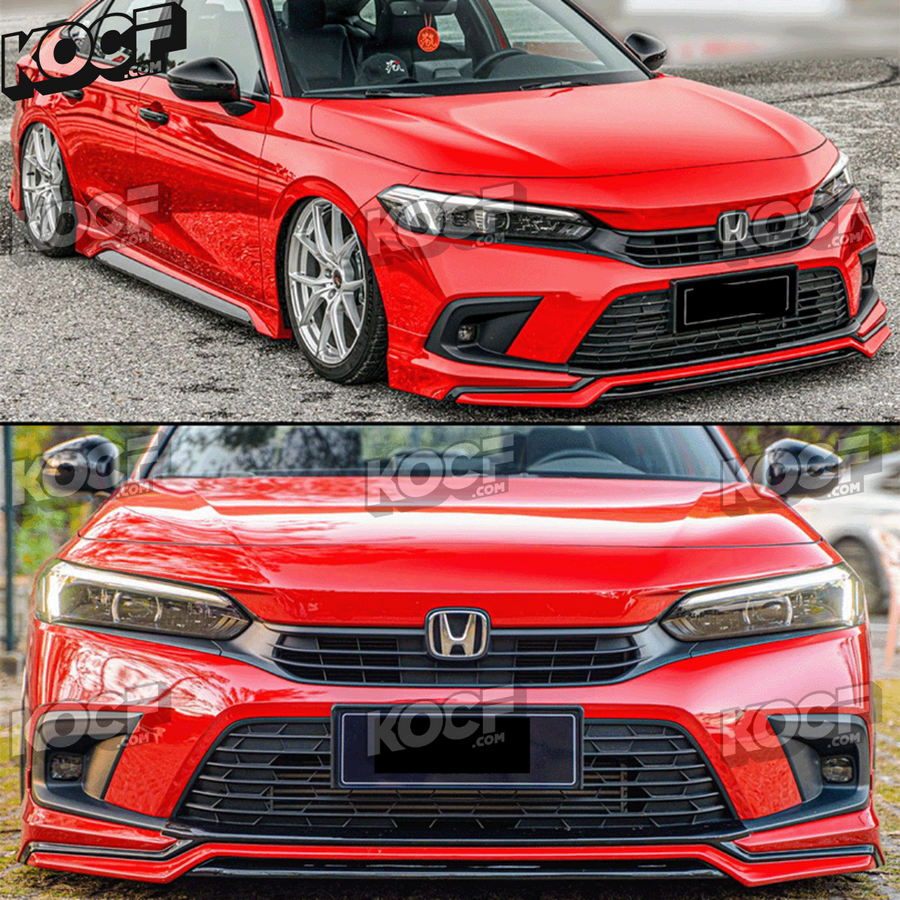
Yofer V2 Deluxe Front Lip
A one-piece bolt-on front lip for the 2022-present Civic, sold pre-painted in four factory Honda colours so it can match the car rather than sit on it as a black stripe.
- Bolts on with hardware, not tape
- Offered in Platinum White Pearl, Crystal Black Pearl, Rallye Red and Aegean Blue Metallic
- Designed from 3D scans of the bumper
- One piece, so there are no seams to line up
- A low lip is the first thing to meet a steep driveway
- Pre-painted only matches if your factory code matches and your paint has not faded
- Shipping is quoted at 5 to 20 days
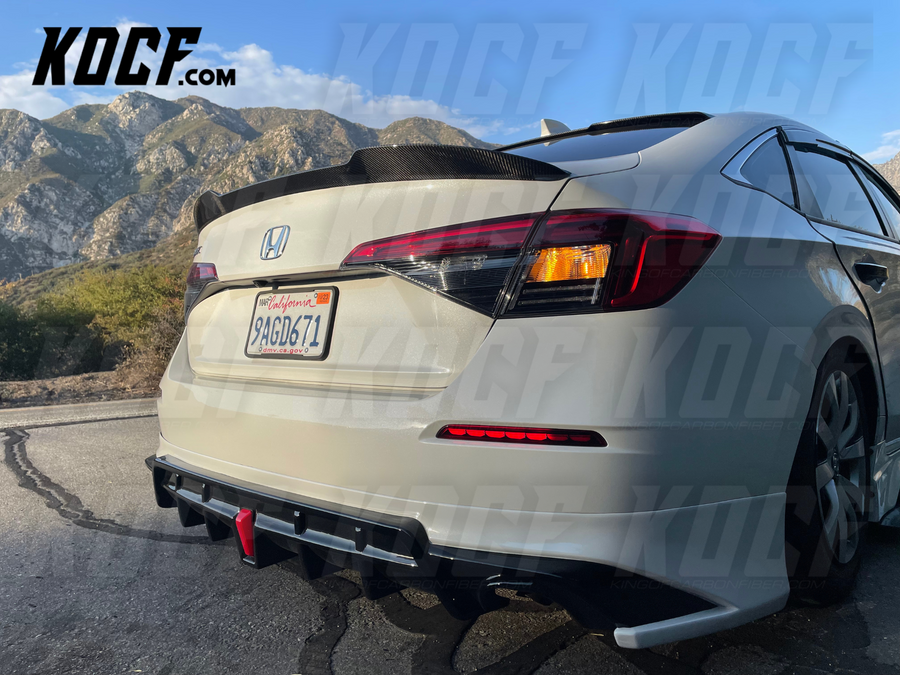
V-Style Carbon Fiber Trunk Spoiler
Real carbon fiber, not a wrap or printed film, in a low V-style profile on the trunk lid. Sold in separate sedan and hatchback fitments.
- 100% real carbon fiber weave
- Sedan and hatchback versions are cut differently rather than shared
- 3D-scanned for fitment
- No drilling — it tapes on
- Tape installation is unforgiving: place it wrong once and you are removing adhesive from paint
- The seller states there may be slight gaps if installation is off
- Bare carbon yellows in sunlight unless the clear coat is maintained
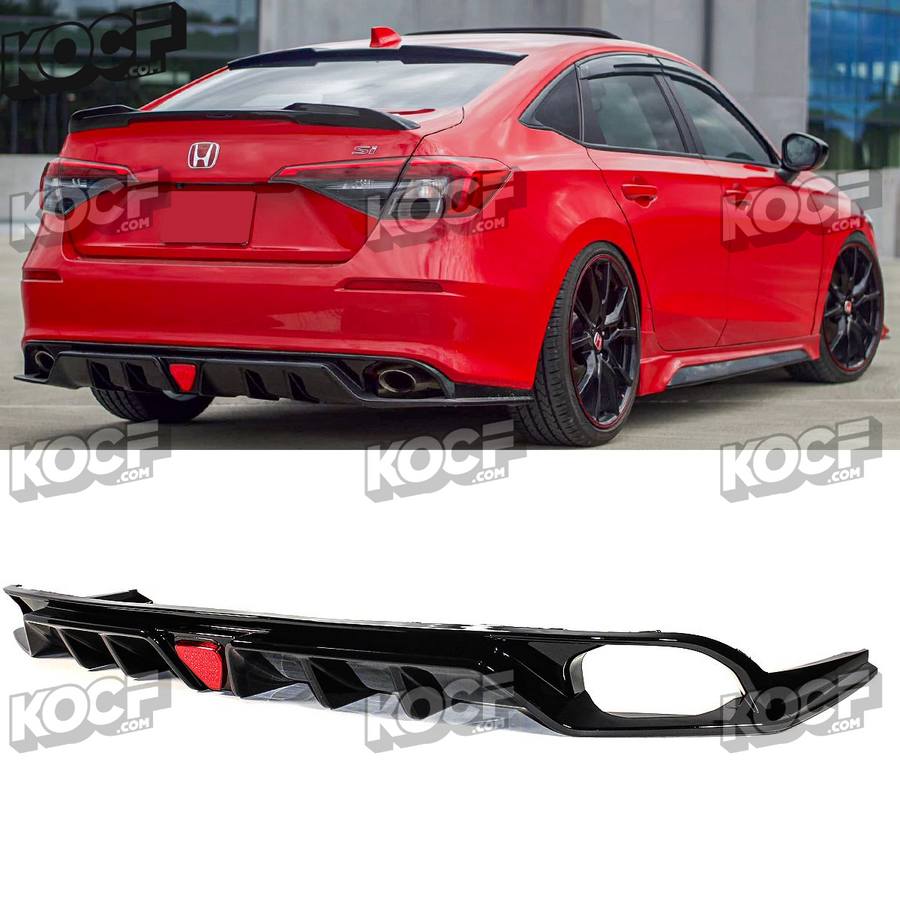
MC Style LED Rear Diffuser (Sedan)
A hardware-mounted rear diffuser with integrated LED for the four-door Civic. It fills the flat area under the rear bumper, which is where the 11th gen looks most unfinished from behind.
- Bolts on with hardware rather than tape
- Integrated LED element
- Sedan-specific mould, not a universal panel
- Sedan only — it will not fit the hatchback
- The LED needs a power source, which means running a wire and doing it properly
- Sits low and close to the exhaust exit
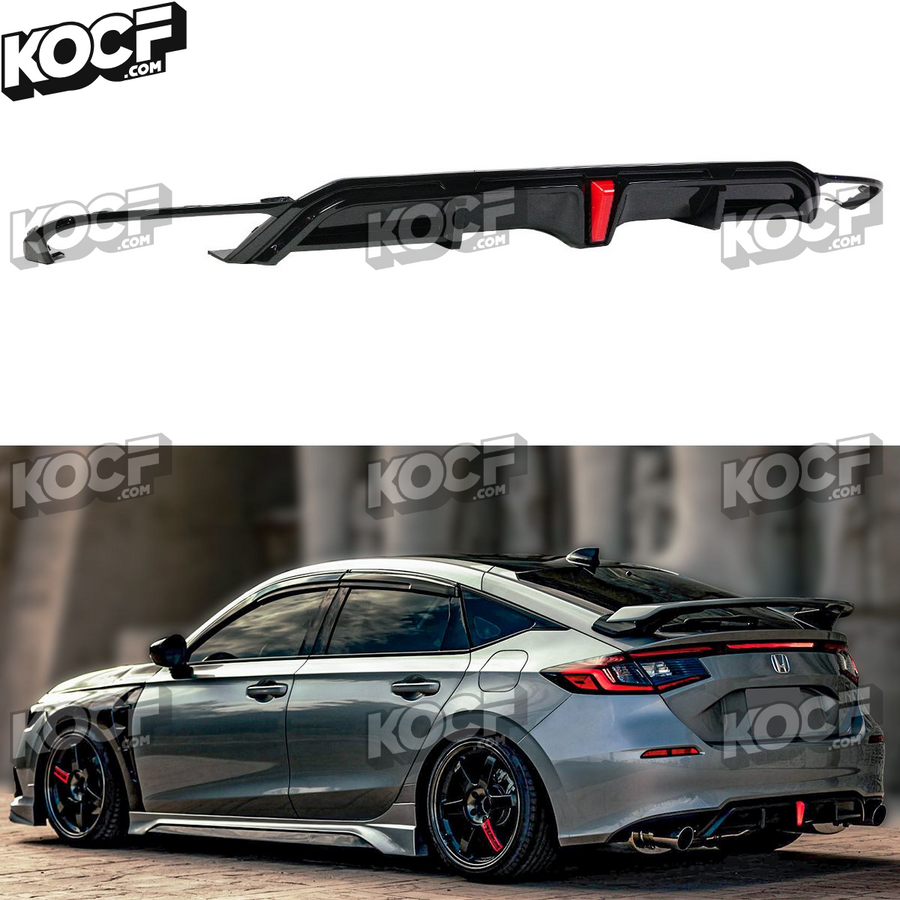
Yofer V1 LED Shark Fin Diffuser (Hatchback)
The hatchback equivalent: a shark-fin diffuser with an LED element, cut for the five-door rear bumper rather than adapted from the sedan part.
- Hatchback-specific mould
- Shark fin profile is the most recognisable diffuser style on this platform
- Hardware mounted
- Hatchback only
- Shark fin fins are the most exposed part of the car to kerbs and speed bumps
- Same LED wiring consideration as the sedan version
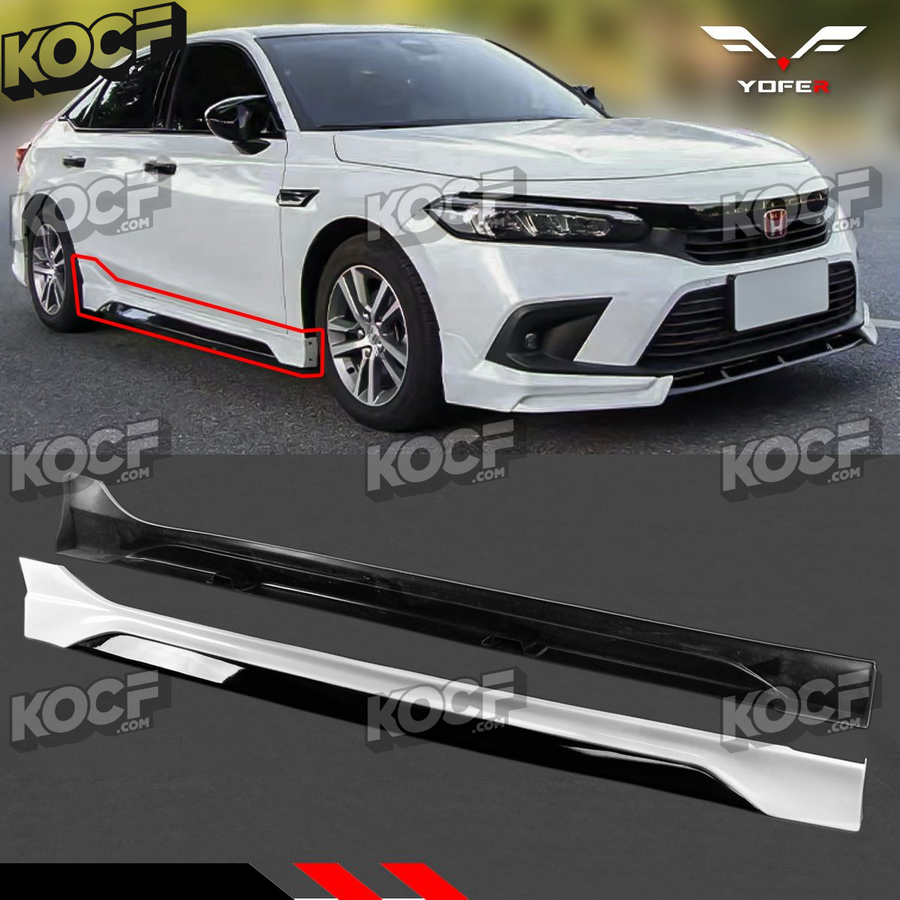
Side Skirts (Sedan)
Rocker extensions for the four-door Civic. On their own they are subtle; with a front lip and a diffuser they are what makes the car read as lowered rather than as a stock car with parts stuck on.
- Visually connects the front lip and rear diffuser
- Modest drop in visual ride height without touching suspension
- Sedan-specific fitment
- Almost invisible without the front and rear pieces
- Reduces jack point clearance — worth checking before your next tyre change
- Sedan only
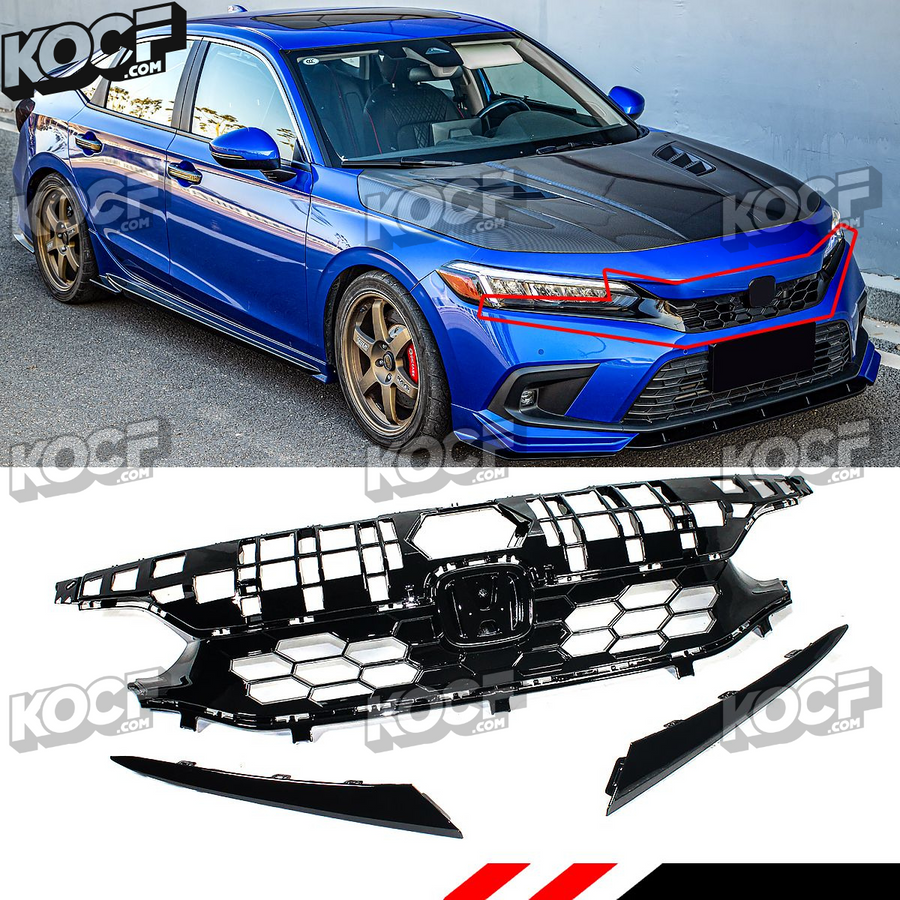
Sport Front Grille (Non-Si Sedan)
A replacement grille that gives the non-Si sedan the darker, more aggressive face the Si gets from the factory. It swaps the single largest visual element on the car.
- Changes the character of the front end more than any other single part
- Direct replacement — no cutting
- Removes the chrome trim that dates the base car
- Explicitly for non-Si sedans; the Si and hatchback bumpers differ
- Grille removal on the 11th gen means taking the bumper cover partly off
- Some sensor and camera brackets must be transferred over, which is fiddly
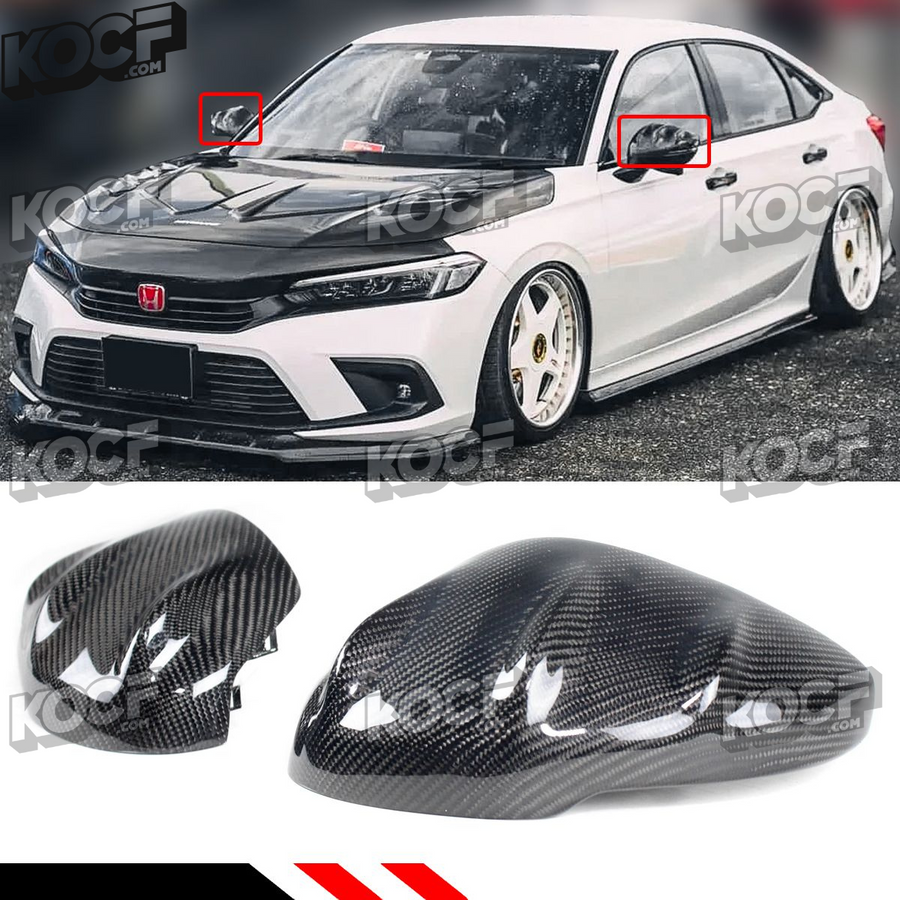
Mirror Covers
Snap-over mirror caps that fit every 11th gen Civic. The lowest-commitment change here: no adhesive on paint, no hardware, and reversible in a minute.
- Fits all models — no sedan/hatch or Si/non-Si trap
- Genuinely reversible
- No paint contact and no drilling
- Covers rather than replacements, so they sit slightly proud of the original
- On a car with no other changes they look arbitrary
- Trapped dirt between cap and mirror can mark the original over time
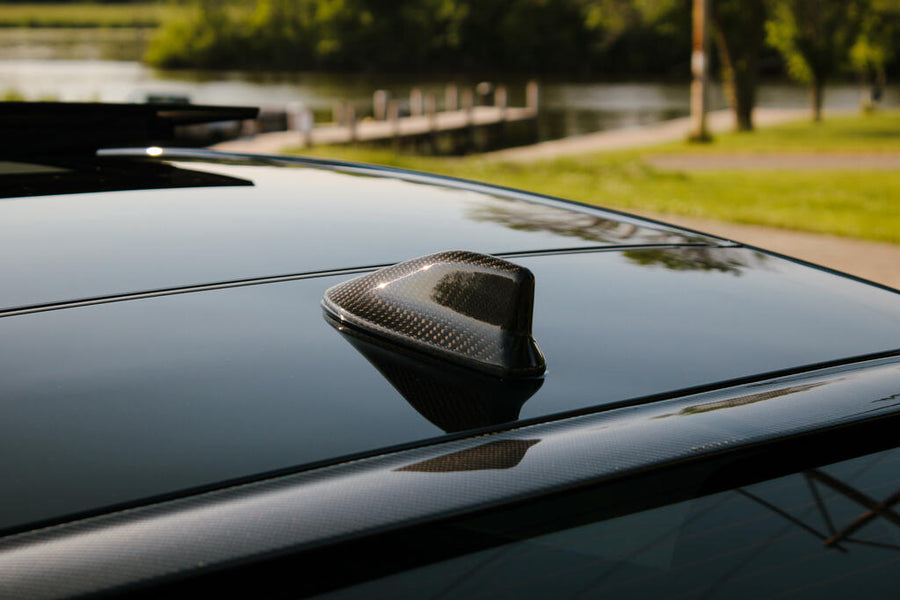
Carbon Fiber Shark Fin Antenna Cover
A carbon fiber cover for the roof antenna. Purely cosmetic, and the sort of thing that only makes sense once the larger parts are already on the car.
- Real carbon, matching a carbon spoiler if you fit one
- Slips over the existing antenna — nothing is removed
- Cheapest way to add a carbon element
- Adds height to the roofline, which matters in a tight garage or an automatic car wash
- It covers the antenna housing, so check reception afterwards
- Bare carbon on the roof takes the most UV exposure of any panel on the car
Tape or hardware?
This is the single most useful thing to understand before your first order, because it decides how much a mistake costs.
Tape-mounted parts — the spoiler, the antenna cover, most mirror caps — attach with double-sided automotive tape. Nothing is drilled, nothing is permanent in principle, and the part can come off later. In practice the first placement is the one you get: cured automotive tape does not want to move, and removing it involves heat, fishing line and adhesive remover on your clear coat. The seller’s own instructions are worth following exactly — mock fit first, mark both ends with painter’s tape as a guide, clean with alcohol, warm the tape, then press and hold for a full minute.
Hardware-mounted parts — the front lip, the diffusers, side skirts — bolt or screw into existing points, sometimes with additional clips. These are more forgiving: if it sits crooked, you loosen it and try again. They also take longer, and the diffusers in particular mean working under the rear bumper on your back.
If you have never fitted a body part before, start with the mirror caps, then the front lip. The lip teaches you mock-fitting and hardware without risking anything you cannot undo.
Each part in detail
1. Yofer V2 Deluxe Front Lip — start here
The front lip is the right first purchase for two reasons. It sits where the eye goes first, and it mounts with hardware rather than tape, so a first attempt that goes badly is a wasted afternoon rather than a damaged bumper.
This is the authentic Yofer V2, a one-piece deluxe lip designed from 3D scans of the 11th gen bumper. One-piece matters here: multi-piece lips need the segments aligned with each other as well as with the car, and the joins show under a low sun. It is offered pre-painted in Platinum White Pearl, Crystal Black Pearl, Rallye Red and Aegean Blue Metallic, which covers most of the volume colours on this platform.
What to think about: a lip is the lowest point of the car and it will find your driveway apron, a parking block, or the one speed bump you take too fast. That is not a fault in the part, it is what lips are. If your daily route includes a steep entrance, know that going in. And pre-painted only works if your factory code matches and your paint has not weathered away from it — on a car more than a few years old, a black lip is often the safer choice than a colour-matched one that is nearly right.
2. V-Style Carbon Fiber Trunk Spoiler — the change people notice
This is real carbon fiber, which is worth stating because a great deal of what is sold as carbon on this platform is vinyl wrap or a hydro-dipped pattern. The weave here is structural material, hand-laid, with the shape developed from 3D scans.
The V-style profile is low and reads as factory-optional rather than aftermarket, which is the right register for a Civic that is otherwise stock. Crucially, it is sold in separate sedan and hatchback versions rather than one part claimed to fit both — pick the wrong one and it will not sit down on the trunk lid.
What to think about: it tapes on, and the seller is unusually frank that poor installation leaves slight gaps. Follow their sequence: mock fit, mark with blue tape, clean with alcohol, heat the adhesive, press and hold for sixty seconds, and use 3M or an equivalent quality double-sided tape rather than whatever came in the box. The other consideration is UV — exposed carbon yellows over years unless the clear coat is good and stays that way. A car that lives outdoors will show this before a garaged one does.
3. MC Style LED Rear Diffuser — sedan only
The rear of the 11th gen sedan has a large flat area below the bumper that the factory leaves plain. A diffuser fills it, and it is the single biggest improvement available to the back of this car.
The MC style is hardware-mounted, moulded specifically for the four-door bumper, and carries an integrated LED element. It is not a universal panel trimmed to fit, which matters on a surface with this much curvature.
What to think about: the LED needs power, and how you get it there is the real job. Splicing into a reverse or brake circuit should be done with proper connectors and a fuse, not by twisting wires and taping them — a short in a rear lighting circuit is a genuine safety issue, not just an inconvenience. If you are not comfortable doing that, budget for an auto electrician or fit it without wiring the LED. The diffuser also sits low and near the exhaust exit, so heat and kerb contact are both worth a look before committing.
4. Yofer V1 LED Shark Fin Diffuser — hatchback only
The hatchback equivalent, and a genuinely different part rather than the sedan mould stretched. The shark-fin profile — vertical fins running back from the bumper — is the most recognisable diffuser shape on this platform, and it suits the hatch’s shorter rear overhang better than a flat panel would.
What to think about: those fins are the most exposed thing on the car. They protrude downward and rearward, which is precisely the direction a parking block, a steep exit or a tow hook comes from. Same LED wiring caveat as the sedan version. And as with everything on this list, hatchback-only means hatchback-only.
5. Side Skirts — sedan
Side skirts are the part that makes no sense on their own and is essential once you have the other two. Fitted to an otherwise stock car they read as a slight thickening of the rocker panel that nobody notices. Fitted between a front lip and a rear diffuser, they connect the two and the car reads as one lowered shape instead of three separate additions.
What to think about: they reduce clearance where you jack the car. Before fitting, find out where your jack and your local tyre shop’s lift arms go, and check the skirts do not cover those points — discovering this in a tyre bay is an expensive way to learn it. Sedan-specific fitment.
6. Sport Front Grille — non-Si sedan
If you have one change to make and want the largest visual return, it is the grille. It is the biggest single surface on the front of the car, and on a base 11th gen it is the element that most marks the car out as the cheap one. A darker sport grille closes the gap to the Si without touching anything else.
This is a direct replacement rather than an overlay, so there is no cutting, and it removes the chrome accent that dates the LX and Sport trims.
What to think about: it is listed for non-Si sedans, and that restriction is real — the Si bumper aperture differs. Fitting is also more involved than it sounds: reaching the grille clips on the 11th gen means at least partly removing the front bumper cover, and anything mounted in or behind the grille (parking sensors, the adaptive cruise radar, a camera bracket) has to be transferred and re-seated correctly. A misaligned radar bracket is not a cosmetic problem. If your car has Honda Sensing and you are unsure, this is the part on the list worth paying someone to fit.
7. Mirror Covers — every model
The easiest change here by a wide margin. These snap over the existing mirror housings, fit all 11th gen Civics regardless of body style or trim, touch no paint and involve no hardware. If you decide you dislike them, they come off in a minute and there is no evidence they were ever there.
What to think about: they are covers, not replacements, so they sit fractionally proud of the original housing — visible from a metre away, invisible from three. Over time, grit that works its way between the cap and the housing can scuff the paint underneath, so pull them off and clean under them occasionally. And on a car with nothing else changed, a pair of contrasting mirror caps looks less like a choice and more like a replacement after a collision.
8. Carbon Fiber Shark Fin Antenna Cover — the finishing detail
A real carbon cover that slips over the factory roof antenna. It does nothing at all except add a carbon element at the top of the car, and it makes sense chiefly as a match for a carbon spoiler.
What to think about: it adds height to the highest point of the car, which is a real consideration for a tight garage and for automatic car washes with a rotating top brush. It also encloses the antenna housing, so check radio and any connected-services reception after fitting rather than assuming. And the roof takes more UV than any other panel, so bare carbon up there ages fastest.
Carbon fiber, painted, or neither
Real carbon fiber is the expensive option and looks it, but only in good light and only if it stays clear-coated. It is light, it does not dent, and it yellows under UV over a period of years. It suits parts that sit high and catch light — a spoiler, an antenna cover, mirror caps.
Painted parts disappear into the car, which is the point. On a front lip or side skirts, colour-matched is the mature choice and gloss black is the loud one. The risk is match: a factory code on a new part against five-year-old paint on a bumper is a near miss rather than a match, and near misses are more noticeable than a deliberate contrast.
Unpainted ABS or gloss black is the honest middle. It never pretends to match, it hides stone chips, and on a white or red car the contrast is a legitimate look rather than a compromise. It is also the only one of the three that survives a kerb strike without needing a body shop.
One thing worth saying plainly: none of these parts is a performance part. A road-car diffuser, lip or wing at legal speeds changes how the car looks, not how it goes. Anyone selling this platform on downforce is selling you something else.
FAQ
Will any of this void my Honda warranty?
In the US the Magnuson-Moss Warranty Act means a manufacturer cannot void your whole warranty for fitting an aftermarket part. They can decline a claim for damage the part caused. Cosmetic body parts that bolt or tape on are low risk; the exception is anything that disturbs a sensor or camera — the grille job in particular — where a subsequent driver-assistance fault could reasonably be traced back to the work.
Do I need a professional to fit these?
Mirror caps, the antenna cover and the front lip are realistic home jobs with basic tools and patience. Side skirts and diffusers are doable but mean time under the car. The grille is the one we would hand over, because of the bumper removal and the sensor brackets behind it.
Will a lip or diffuser affect my insurance?
Modifications generally need declaring, and undeclared ones can complicate a claim. Cosmetic body parts are usually a minor rating factor, but the practical risk is that a lip damaged in a collision is not replaced under a policy that never knew it existed. A short call to your insurer is cheaper than finding out afterwards.
How do I know whether carbon is real?
Real carbon has a weave that follows the curvature of the part, and the pattern distorts where the surface does. A printed or hydro-dipped finish has a weave that stays perfectly regular across a curve, and often repeats visibly. Listings that describe the material explicitly — as these do — are a better signal than listings that only say “carbon look”.
Is it better to buy a full body kit at once?
Only if you are certain about the look. Buying in stages lets you live with each change, and it spreads the risk of a fitment mistake across separate orders instead of one large one. The order we suggest — lip, spoiler, diffuser, skirts — also happens to run from easiest to hardest.
For a wider look at the seller itself, our KOCF review covers the catalogue beyond the Civic, the fitment language they use, and what to check before ordering.