
 Victoria
BuyerRank is reader-supported. We may earn a commission when you buy through links on this page, at no extra cost to you. As an Amazon Associate, we earn from qualifying purchases. Prices and availability are accurate as of the date of publication and can change at any time — please check the retailer for the current price. Learn more. Written by Victoria — how we choose what to recommend.
Our quick picks
Ranked by what each one is best at, not by a score we made up. Ratings are what the product showed on Amazon when we last checked — how we rank.
- Seven amp hours – for accessories, not for a house battery.
- This is not an RV house battery and should not be bought as one.
- A 100A BMS with proper temperature cut-offs, expandable to a serious bank.
- One hundred amp hours in a Group 24 case is the standard RV house battery, and what separates good ones is the BMS.
- Three hundred amp hours in one case, with Bluetooth monitoring.
- Three hundred amp hours in a single battery means one connection, one BMS and one thing to monitor, instead of three batteries wired in parallel with the balancing problems that brings.
- A metal shell instead of plastic, which matters in a vehicle.
- Most lithium batteries ship in plastic cases.
- Five hundred amps peak – enough for motors and inverters that surge.
- Continuous current tells you what a battery runs; peak current tells you what it can start.
- The standard specification at the lowest price in this group.
- A 100A BMS, high-density cells, low self-discharge and a long cycle rating – the specification list matches batteries costing considerably more.
- IP67 rated in a standard Group 24 case.
- IP67 means the battery survives dust and temporary immersion, which matters if it is mounted in an exterior locker, on a trailer tongue, or anywhere water gets in.
- Full charge in around five hours, in a Group 31 case.
- Charging speed matters more than people expect when you rely on a generator or on limited daylight for solar.
- Two hundred amp hours in one case, using automotive-grade cells.
- Automotive-grade cells and full BMS protection cover the fundamentals.
- Self-heating – the only battery here you can charge below freezing.
- A self-heating battery warms itself before accepting charge, which is what makes lithium viable in cold climates at all.
The full case for each pick, the numbers that matter and the downsides, are all below.
The whole RV battery market has moved to lithium iron phosphate, and for good reason: you can use most of the capacity rather than half of it, it lasts thousands of cycles instead of hundreds, and it weighs considerably less. A 100Ah lithium battery truly replaces a 200Ah lead-acid one.
There is one thing the listings tend not to explain, and it matters more than any other specification: lithium batteries must not be charged below freezing. Doing so plates the cells and permanently reduces capacity. If you camp in winter, you need either a self-heating battery or a charging setup that will not attempt it when cold.
A note on method: we have not tested these batteries ourselves. Our picks are based on manufacturer specifications, BMS features and patterns across owner reports. Cycle life figures are manufacturer claims measured under specific discharge conditions.
How we picked these
We sorted on the specifications that determine what a battery can actually do in a vehicle:
- BMS protections. Low-temperature charge cut-off is the one that saves batteries. High-temperature and over-current protection matter too.
- Continuous and peak current. Continuous decides what you can run; peak decides what you can start.
- Case size and group fitment. Group 24 and Group 31 are different sizes, and RV compartments are not flexible.
- Expandability. Whether the battery can join a larger bank later, or has to be replaced.
Each battery gets a role rather than a rank, because a 7Ah accessory cell and a 300Ah house battery are not comparable products.
At a glance

GOLDENMATE 12V 7Ah LiFePO4 Deep Cycle Battery (2-Pack)
5000+ cycles, 10-year lifespan, IP67 waterproof, lightweight, built-in 15A BMS, fast charging, 7A output, safe LiFePO4 cells, expandable 4S/4P, great for UPS, solar, toys, scooters, and fish finders

VATRER POWER 12V 100Ah Group 24 LiFePO4 Deep Cycle Battery
100A BMS, high/low temp cutoff, expandable to 20.48kWh, fast solar/generator charging, long-life LiFePO4 cells, portable handle, ideal for RVs, boats, off-grid systems

PUPVWMHB 12V 300Ah Mini LiFePO4 Bluetooth Battery
Bluetooth app monitoring, 200A BMS, up to 15,000 cycles, low-temp cutoff, expandable up to 61.44kWh, safe LiFePO4 chemistry, ideal for RV, solar systems, trolling motors

ECO-WORTHY 12V 150Ah Metal Case LiFePO4 Bluetooth Battery
Metal shell for safety, Bluetooth monitoring, built-in 120A BMS, 15,000+ cycles, lightweight design, 1920Wh capacity, low-temp cutoff protection, perfect for solar, RV, camper, marine, trolling motor

WEIZE 12V 100Ah Group 24 Bluetooth LiFePO4 Battery
1.28kWh energy, 100A continuous / 500A peak, Bluetooth monitoring, 2000–8000 cycles, built-in 100A BMS with low/high temp protection, lightweight design, perfect for trolling motors, camping, solar, and boating

CHITOLI 12V 100Ah LiFePO4 Battery
10-year lifespan, 4000–15000 cycles, built-in 100A BMS, high-density LiFePO4 cells, low self-discharge, no memory effect, expandable 4S4P, Group 24 size, ideal for RV, marine, camping, trolling motors

HumsiENK 12V 100Ah LiFePO4 Battery
15,000+ cycles, 10-year lifespan, built-in 100A BMS, IP67 waterproof, Group 24 size, expandable to 48V/20.48kWh, fast 2-hour charging, lightweight design—ideal for RV, solar, marine, and trolling motors.

Power Queen 12V 100Ah LiFePO4 Group 31 Battery
Long-life LiFePO4 with 15000+ cycles, built-in 100A BMS, fast 5-hour charging, lightweight Group 31 size, expandable 4S4P, 1280Wh energy—ideal for RV, solar, off-grid, marine, and 30–70 lb trolling motors

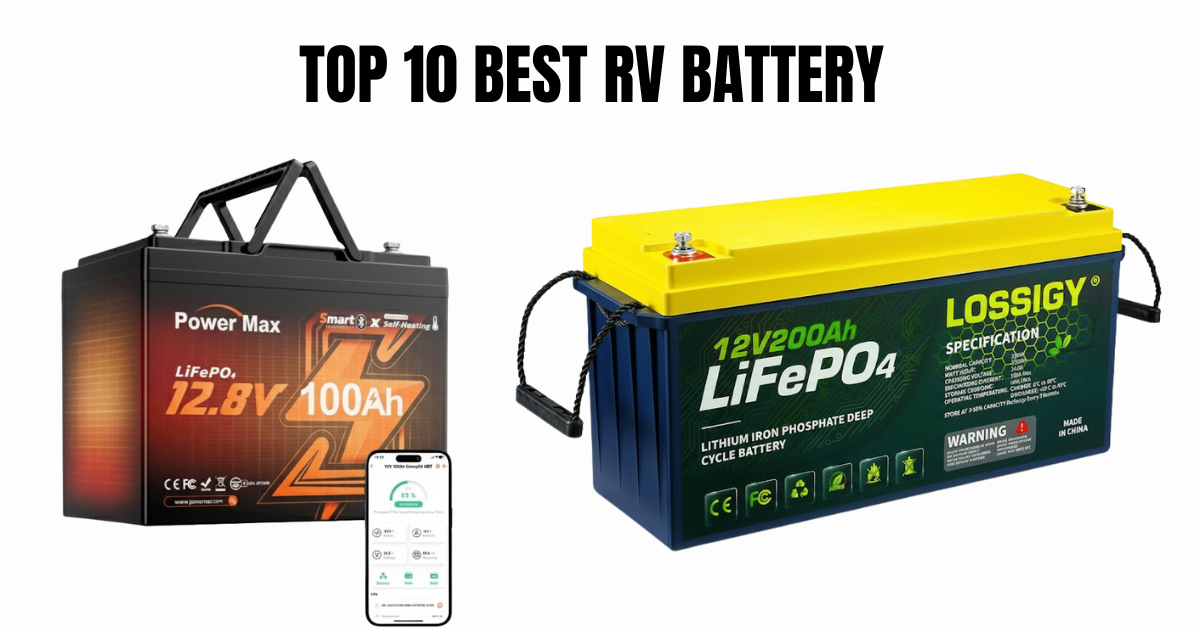
LOSSIGY 12V 200Ah LiFePO4 Battery
Auto-grade LiFePO4 cells, 4000+ cycles, built-in BMS with full protection, lightweight and easy to install, supports series/parallel expansion, ideal for solar, RV, marine, and off-grid setups

Litime 12V 100Ah Group 24 Bluetooth Heating LiFePO4 Battery
Bluetooth monitoring, dual heating modes, 100A smart BMS, low-temp protection, EV-grade LiFePO4 cells, IP65 waterproof, lightweight Group 24 design—ideal for RV, solar, and trolling motors
The 10 Best RV Batteries, Reviewed
1. GOLDENMATE 12V 7Ah LiFePO4 Deep Cycle Battery — Best Small Capacity
Seven amp hours — for accessories, not for a house battery.
This is not an RV house battery and should not be bought as one. What it is good for is the small jobs around a camper: a backup for a control panel, power for a small pump or alarm, a lightweight cell for a trailer accessory. IP67 waterproofing means it survives exterior mounting where a standard battery would not.
What we like
- IP67 waterproof, so it can live in an exterior compartment
- Very light and easy to fit in confined spaces
- 5,000+ cycle rating for a low-cost cell
- Built-in 15A BMS for basic protection
Where it disappoints
- 7Ah is far too small for a house battery — do not buy this to run a fridge
- 15A output limits what it can power at all
- Small capacity means frequent recharging under any real load
- Not expandable into a meaningful bank
Right for: accessories, backups and small devices. Skip it if: you are powering a camper.
Check the current price on Amazon →
2. VATRER POWER 12V 100Ah Group 24 LiFePO4 — Best Overall
A 100A BMS with proper temperature cut-offs, expandable to a serious bank.
One hundred amp hours in a Group 24 case is the standard RV house battery, and what separates good ones is the BMS. High and low temperature cut-offs protect the cells from charging in freezing conditions, which is the most common way lithium batteries get quietly destroyed. Expandability to 20.48kWh means this scales with your system rather than being replaced by it.
What we like
- 100A BMS with high and low temperature cut-offs
- Expandable to 20.48kWh in a larger bank
- Group 24 case fits standard RV battery compartments
- Accepts fast charging from solar or a generator
The drawbacks
- 100Ah usable is less than it sounds once you account for real loads
- Lithium requires a compatible charger or converter
- Cannot be charged below freezing without a heated model
- Heavier than the smaller cells here
Right for: a standard RV house battery that will grow into a bank. Skip it if: you camp in sub-freezing temperatures regularly.
Check the current price on Amazon →
3. PUPVWMHB 12V 300Ah Mini LiFePO4 Bluetooth Battery — Best Large Capacity
Three hundred amp hours in one case, with Bluetooth monitoring.
Three hundred amp hours in a single battery means one connection, one BMS and one thing to monitor, instead of three batteries wired in parallel with the balancing problems that brings. A 200A BMS supports substantial simultaneous loads, and Bluetooth monitoring lets you see state of charge without crawling into a locker.
What we like
- 300Ah in a single case avoids parallel-wiring complications
- 200A BMS supports heavy simultaneous loads
- Bluetooth monitoring of charge state and health
- Expandable to 61.44kWh for large systems
The catch
- Large and heavy — check compartment dimensions and floor loading
- Higher upfront cost than smaller batteries
- Low-temperature cut-off protects but does not heat
- A single large battery is a single point of failure
Right for: full-time RV living and large solar systems. Skip it if: your compartment or budget is limited.
Check the current price on Amazon →
4. ECO-WORTHY 12V 150Ah Metal Case LiFePO4 — Best Build Quality
A metal shell instead of plastic, which matters in a vehicle.
Most lithium batteries ship in plastic cases. A metal shell is more resistant to impact, vibration and heat, which is worth something in a vehicle that spends its life moving. At 150Ah it sits usefully between the standard 100Ah and the large 300Ah options, with Bluetooth monitoring and a 120A BMS.
What we like
- Metal case is more robust in a moving vehicle
- 150Ah is a useful step up from the standard 100Ah
- Bluetooth monitoring built in
- 15,000+ cycle rating
Where it falls short
- Metal case adds weight
- Larger than standard Group 24 compartments — measure first
- No internal heating for cold-weather charging
- Costs more than a plastic-cased equivalent
Right for: rough roads and permanent installations. Skip it if: weight or compartment size is critical.
Check the current price on Amazon →
5. WEIZE 12V 100Ah Group 24 Bluetooth LiFePO4 — Best Peak Output
Five hundred amps peak — enough for motors and inverters that surge.
Continuous current tells you what a battery runs; peak current tells you what it can start. A 500A peak matters if you run an inverter with a compressor load, a winch, or anything with a startup surge. Bluetooth monitoring and a 100A continuous rating cover the everyday side.
What we like
- 500A peak handles inverter and motor startup surges
- Bluetooth monitoring included
- Standard Group 24 fitment
- 1.28kWh of usable energy
What owners complain about
- Cycle rating quoted as 2,000–8,000 is lower than some competitors
- 100A continuous is standard rather than exceptional
- No internal heating
- Peak ratings are brief by definition — check the duration
Right for: systems with inverters and surge loads. Skip it if: your loads are steady and low.
Check the current price on Amazon →
6. CHITOLI 12V 100Ah LiFePO4 Battery — Best Value
The standard specification at the lowest price in this group.
A 100A BMS, high-density cells, low self-discharge and a long cycle rating — the specification list matches batteries costing considerably more. For a first lithium battery, or for someone building a bank on a budget, the compromise is brand track record rather than capability on paper.
What we like
- Low cost for a 100Ah LiFePO4 battery
- 100A BMS with standard protections
- Low self-discharge for seasonal storage
- Long quoted cycle life
The downside
- Less established brand — warranty support is the unknown
- No Bluetooth monitoring
- Cycle ratings quoted as a wide range
- No internal heating for cold charging
Right for: budget builds and first lithium batteries. Skip it if: long-term warranty support is decisive.
Check the current price on Amazon →
7. HumsiENK 12V 100Ah LiFePO4 Battery — Best Weatherproofing
IP67 rated in a standard Group 24 case.
IP67 means the battery survives dust and temporary immersion, which matters if it is mounted in an exterior locker, on a trailer tongue, or anywhere water gets in. Combined with a 15,000+ cycle rating and expandability to a 48V bank, it is a sensible choice for installations that are not fully protected.
What we like
- IP67 rating suits exterior and exposed mounting
- 15,000+ cycle rating
- Group 24 standard fitment
- Expandable to 48V/20.48kWh systems
What you give up
- No Bluetooth monitoring
- No internal heating
- IP67 does not mean it can be permanently submerged
- 100Ah is standard rather than generous
Right for: exterior lockers and exposed installations. Skip it if: you want app monitoring.
Check the current price on Amazon →
8. Power Queen 12V 100Ah LiFePO4 Group 31 — Best Fast Charging
Full charge in around five hours, in a Group 31 case.
Charging speed matters more than people expect when you rely on a generator or on limited daylight for solar. A five-hour full charge means a morning of sun or a shorter generator run does the job. Group 31 is a larger case than Group 24, so check your compartment before ordering.
What we like
- Around five hours to a full charge
- 15,000+ cycle rating
- Lightweight for its capacity
- Expandable into larger banks
The part that annoys people
- Group 31 is larger than Group 24 — measure the compartment
- Fast charging needs a charger capable of delivering it
- No internal heating
- 100Ah standard capacity
Right for: generator and solar charging where time is limited. Skip it if: your battery box is Group 24.
Check the current price on Amazon →
9. LOSSIGY 12V 200Ah LiFePO4 Battery — Best Mid-Large Capacity
Two hundred amp hours in one case, using automotive-grade cells.
Two hundred amp hours is the capacity most serious RV users end up at: enough to run a compressor fridge, lights and charging for several days without sun, in a single battery rather than two wired together. Automotive-grade cells and full BMS protection cover the fundamentals.
What we like
- 200Ah in a single case avoids parallel wiring
- Automotive-grade cells
- Full BMS protection
- Supports series and parallel expansion
Where it disappoints
- Heavy — check compartment and floor loading
- 4,000+ cycles is lower than some competitors here
- No Bluetooth monitoring
- No internal heating
Right for: several days off-grid without recharging. Skip it if: you need the highest cycle life.
Check the current price on Amazon →
10. Litime 12V 100Ah Group 24 Bluetooth Heating LiFePO4 — Best for Cold Weather
Self-heating — the only battery here you can charge below freezing.
This is the single most important specification for anyone camping in winter, and almost no listing explains it: lithium batteries must not be charged below freezing, and doing so permanently damages the cells. A self-heating battery warms itself before accepting charge, which is what makes lithium viable in cold climates at all.
What we like
- Self-heating — allows charging in sub-freezing conditions
- Bluetooth monitoring with dual heating modes
- Smart 100A BMS with low-temperature protection
- EV-grade cells with IP65 protection
The drawbacks
- Heating draws power from the battery itself
- More expensive than non-heated equivalents
- IP65 rather than IP67
- 100Ah standard capacity
Right for: winter camping and cold climates. Skip it if: you only travel in warm weather.
Check the current price on Amazon →
How to Choose an RV Battery
Work out your daily amp-hour consumption first
Add up what you run and for how long: a compressor fridge, lights, water pump, phone and laptop charging, any inverter loads. That daily total, multiplied by the number of days you want between charges, is your capacity requirement. Buying a battery without doing this is how people end up with half of what they need.
Understand the lithium cold-charging problem
LiFePO4 cells can be discharged in freezing conditions but must not be charged below about 32°F. Charging a cold lithium battery causes permanent damage. Most batteries have a BMS that blocks charging when cold — which protects the battery but means you cannot recharge at all. A self-heating battery solves this properly.
Check your charger and converter
Lithium batteries need a charging profile different from lead-acid. An old converter set for flooded lead-acid will undercharge a lithium bank permanently. Check that your converter, solar controller and alternator charging setup all support a LiFePO4 profile before buying.
Match the case to your compartment
Group 24 and Group 31 are standard sizes with different dimensions. Measure your battery compartment, including height for terminals and cables, before ordering. Some large-capacity batteries do not fit standard compartments at all.
Decide whether you want Bluetooth
App monitoring lets you see state of charge, current and cell health without accessing the battery. In an RV, where batteries live in awkward lockers, that is useful — and knowing your real state of charge changes how you manage power.
Common mistakes
- Charging lithium below freezing. Permanent, invisible damage.
- Keeping a lead-acid charging profile. The bank never reaches full charge.
- Buying capacity without measuring the compartment. Common and expensive.
- Mixing old and new batteries in a bank. The weakest cell governs the whole bank.
- Ignoring peak current. Inverters and motors surge well above their running draw.
Frequently Asked Questions
How much battery capacity do I need for an RV?
It depends entirely on your loads. A compressor fridge alone can use 30–60Ah per day. Many weekend users are comfortable with 100Ah; full-timers with solar commonly run 200–400Ah. Calculate your daily consumption rather than guessing.
Can I charge a lithium battery in freezing weather?
Not unless it is a self-heating model or is warmed some other way. Charging LiFePO4 below freezing causes permanent damage, which is why most BMS systems block it. This is the main argument for a heated battery in cold climates.
Is lithium worth it over lead-acid?
For most RV users, yes. You can use most of a lithium battery’s capacity against roughly half of a lead-acid battery’s, it lasts many times longer in cycles, and it weighs far less. The upfront cost is higher; the cost per usable amp-hour over its life is lower.
Do I need a special charger?
You need a charger, converter and solar controller that support a LiFePO4 profile. Lead-acid profiles will chronically undercharge lithium batteries, and some equalisation modes can damage them.
Can I mix lithium and lead-acid batteries?
Not in the same bank. They have different charging profiles and voltage curves, and combining them results in poor charging and potential damage to both.
What does the BMS actually do?
The battery management system protects the cells: it cuts off charging when too cold or too hot, limits current, prevents over-discharge, and balances cells. It is the component that determines how long the battery lasts and how safe it is.
If you only read one section
For a standard RV house battery, the VATRER POWER 100Ah has the BMS protections that matter and expands into a larger bank later. If you need more than a couple of days off-grid, step up to the LOSSIGY 200Ah or the PUPVWMHB 300Ah rather than wiring several small batteries together.
If you camp in winter, the Litime heated battery is the only pick here you can actually charge below freezing, and that single capability outweighs every other specification on this page in a cold climate.
Before ordering, measure your compartment and check that your charger supports a lithium profile. Those two things cause more disappointment than any battery specification.
Prices and availability on Amazon change frequently — check the product page for current information before buying.