 Victoria
BuyerRank is reader-supported. We may earn a commission when you buy through links on this page, at no extra cost to you. As an Amazon Associate, we earn from qualifying purchases. Prices and availability are accurate as of the date of publication and can change at any time — please check the retailer for the current price. Learn more. Written by Victoria — how we choose what to recommend.
Our quick picks
Ranked by what each one is best at, not by a score we made up. Ratings are what the product showed on Amazon when we last checked — how we rank.
- The hybrid body most people should buy, and the one hardest to outgrow.
- The A7 IV sits at the point where Sony’s stills and video capabilities meet without either being compromised.
- For landscape, architecture and studio work where you crop and print large.
- If your work involves printing large, cropping aggressively, or capturing fine texture in landscape and architecture, the resolution here is the reason to choose it over the A7 IV.
- An older body that is still a better buy than most new cameras.
- Supplied here with a 28-70mm lens, it is a complete starting kit rather than a body alone.
- The one that fits in a jacket pocket and still beats a phone.
- The argument for a premium compact is narrower than it used to be, because phones have improved enormously.
- Interchangeable lenses in a body designed specifically for talking to camera.
- The ZV line is built around video-first ergonomics: a fully articulating screen, a microphone arrangement that works without an external mic, and controls placed for someone filming themselves.
- Fixed wide lens, no decisions to make, straight out of the box.
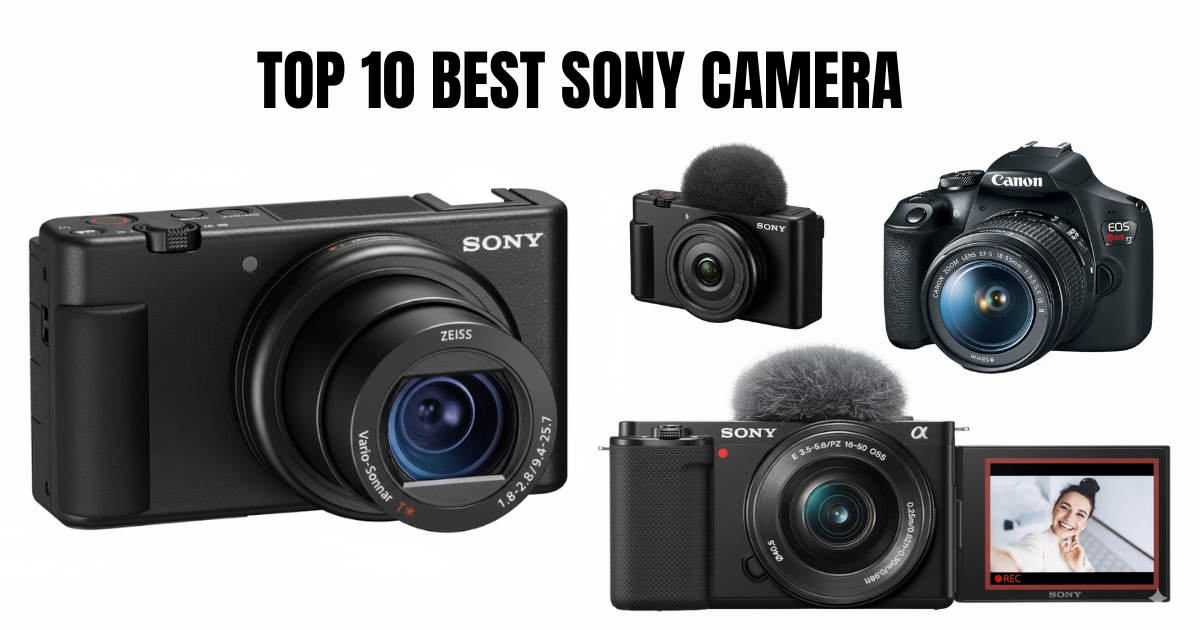
- The ZV-1F strips out the choices: a fixed wide-angle lens suited to arm’s-length filming, simple controls, and 4K video with reliable autofocus.
- The zoom version, with better audio and HDR video.
- Where the ZV-1F is fixed, the ZV-1 has a zoom lens, which makes it far more versatile for filming anything other than your own face – product shots, scenery, subjects at a distance.
- The sensible everyday camera: smaller, lighter and cheaper than full-frame.
- APS-C is the format most people should start with and many should stay with – smaller bodies, much smaller and cheaper lenses, and image quality that is well beyond what most uses require.
Below: why each one made the list, the numbers worth comparing, and what is wrong with it.
Choosing a Sony camera is mostly a question of which of three decisions you are actually making: full-frame or APS-C, stills-first or video-first, and interchangeable lens or fixed. Get those right and almost any body in the range will do the job. Get them wrong and the most expensive camera here will sit unused.
The other thing worth saying early: the body is the smaller half of the purchase. Lenses cost more over time, they last longer than bodies, and they make more difference to an image. Choosing a system matters more than choosing a model.
A note on method: we have not shot with these cameras ourselves. Our picks are based on manufacturer specifications, sensor and autofocus generation, and patterns across owner and professional reports.
How we picked these
We sorted the current Sony range on the things that actually change what you can shoot:
- Sensor size. Full-frame for low light and shallow depth of field; APS-C for smaller, cheaper, lighter systems; 1-inch for pocketability.
- Autofocus generation. Sony’s subject-tracking has improved substantially in recent bodies, and it is the difference between keeping focus on a moving subject and not.
- Stills-first or video-first ergonomics. The ZV line is built for filming yourself; the Alpha line is not.
- Total system cost. A cheaper body in an expensive lens format is not the cheaper option.
Each camera gets a role rather than a rank, because a landscape body and a vlogging camera are not competing purchases.
Quick comparison

Sony Alpha 7 IV Mirrorless Camera
A high-resolution 33MP full-frame sensor delivers sharp, detailed images, paired with fast, accurate autofocus and a versatile 28–70mm lens that adapts to any shooting situation

Sony Alpha 7R V Mirrorless Camera
Delivers outstanding high-resolution image quality, features an advanced autofocus system for precise subject tracking, and comes in a durable, weather-sealed body for reliable performance in any condition

Sony a7 III Full-frame Mirrorless Camera
Excellent low-light performance from its full-frame sensor, paired with a versatile 28–70mm lens for diverse shooting needs and a fast, accurate autofocus system for consistently sharp results

Sony RX100 VII Premium Compact Point-and-Shoot Camera
Features fast autofocus for capturing quick action, a compact travel-friendly design, and impressive 4K video recording for high-quality results anywhere you go

Sony Alpha ZV-E10 Mirrorless Vlogging Camera Kit
Offers flexible lens options for creative shooting, a compact design perfect for travel vlogging, and a user-friendly interface that makes setup quick and easy

Sony ZV-1F Ultra-Compact Vlogging Camera
A compact, travel-ready design makes filming on the go effortless, while high-quality 4K video with reliable autofocus and a beginner-friendly interface ensures smooth, easy content creation

Sony ZV-1 Compact Vlogging Camera
Features a flip screen for effortless self-recording, a built-in microphone for clearer audio, and 4K HDR video that delivers stunning, detailed visuals

Sony Alpha a6400 Interchangeable-Lens Mirrorless Camera
Offers Real-Time Eye Auto Focus for sharper portraits, 4K video for high-quality filming, and a flip-up touchscreen that makes capturing selfies effortless
The 8 Best Sony Cameras, Reviewed
1. Sony Alpha 7 IV — Best Overall
The hybrid body most people should buy, and the one hardest to outgrow.
The A7 IV sits at the point where Sony’s stills and video capabilities meet without either being compromised. A 33MP full-frame sensor gives enough resolution to crop heavily, the autofocus system is the modern subject-tracking implementation rather than an older one, and the video side is strong enough for professional work. It is the body that stops you needing a second body.
What we like
- 33MP is the sensible middle ground — croppable without huge file sizes
- Modern subject-tracking autofocus for people, animals and birds
- Really capable for both photography and video
- Full weather sealing and dual card slots for serious use
Where it falls short
- Body only at this level — budget for lenses, which cost more than the camera over time
- Full-frame lenses are large and heavy compared with APS-C
- More camera than a casual photographer will ever use
- Rolling shutter is present in video, as with most hybrid bodies
Right for: enthusiasts and professionals wanting one body for stills and video. Skip it if: you want something to carry every day without thinking.
Check the current price on Amazon →
2. Sony Alpha 7R V — Best for Resolution
For landscape, architecture and studio work where you crop and print large.
The R line exists for detail. If your work involves printing large, cropping aggressively, or capturing fine texture in landscape and architecture, the resolution here is the reason to choose it over the A7 IV. The autofocus system is also Sony’s most advanced, with subject recognition that holds focus in situations where older systems drift.
What we like
- Highest resolution in this group by a wide margin
- Sony’s most capable autofocus and subject recognition
- Excellent for landscape, architecture, studio and product work
- Files hold up to heavy cropping and large prints
What owners complain about
- Very large files — storage, backup and editing all become slower and more expensive
- High resolution demands good lenses and good technique to be visible
- Overkill for social media and web use
- The most expensive body here
Right for: landscape, studio and commercial work. Skip it if: your images mostly end up on screens.
Check the current price on Amazon →
3. Sony a7 III — Best Value Full-Frame
An older body that is still a better buy than most new cameras.
The a7 III is a previous-generation body, and that is exactly why it is here: full-frame low-light performance, a well-proven autofocus system and access to the entire Sony E-mount lens range, at a price no current full-frame body matches. Supplied here with a 28–70mm lens, it is a complete starting kit rather than a body alone.
What we like
- Full-frame low-light performance at a mid-range price
- Comes with a 28–70mm lens, so it is usable immediately
- Proven, reliable body with a long track record
- Same lens ecosystem as the newest Sony bodies
The downside
- Previous-generation autofocus — good, but behind the A7 IV
- Rear screen and menu system are dated compared with current bodies
- Video specifications lag behind current models
- Being an older model, remaining stock and support windows shorten over time
Right for: a first full-frame camera, or a second body. Skip it if: video is a primary use.
Check the current price on Amazon →
4. Sony RX100 VII — Best Pocket Camera
The one that fits in a jacket pocket and still beats a phone.
The argument for a premium compact is narrower than it used to be, because phones have improved enormously. Where the RX100 VII still wins is reach — a real zoom lens — and autofocus speed on moving subjects. If you want something pocketable that handles a child running or a bird taking off, this is the category.
What we like
- Truly pocketable, which no interchangeable-lens camera is
- Fast autofocus that handles moving subjects
- Real optical zoom rather than digital crop
- 4K video in a body you will actually carry
What you give up
- Small sensor compared with full-frame — low light is a limitation
- Expensive for a compact camera
- Phone cameras have closed much of the quality gap for static subjects
- Small controls are fiddly for people with larger hands
Right for: travel and everyday carry where a bag is not an option. Skip it if: your phone already covers what you shoot.
Check the current price on Amazon →
5. Sony Alpha ZV-E10 Vlogging Kit — Best for Vlogging
Interchangeable lenses in a body designed specifically for talking to camera.
The ZV line is built around video-first ergonomics: a fully articulating screen, a microphone arrangement that works without an external mic, and controls placed for someone filming themselves. The E10 adds interchangeable lenses, which means you can go from a wide vlogging lens to a portrait lens without changing bodies.
What we like
- Designed for filming yourself rather than adapted for it
- Interchangeable lenses — wide for vlogging, longer for other work
- Compact and light enough for handheld use all day
- APS-C sensor is a clear step up from a phone
The part that annoys people
- No in-body stabilisation — handheld walking footage needs a gimbal or a stabilised lens
- Rolling shutter is noticeable on fast pans
- Battery life is modest for long filming days
- Not a photography-first camera
Right for: creators who want lens flexibility. Skip it if: you need stabilised handheld walking shots.
Check the current price on Amazon →
6. Sony ZV-1F — Best Beginner Vlogging Camera
Fixed wide lens, no decisions to make, straight out of the box.
The ZV-1F strips out the choices: a fixed wide-angle lens suited to arm’s-length filming, simple controls, and 4K video with reliable autofocus. For someone starting a channel who does not want to learn lens selection and exposure theory first, removing those decisions is the feature.
What we like
- Fixed wide lens is the right focal length for handheld self-filming
- Simple enough to use immediately
- Compact and light for travel and everyday carry
- Reliable autofocus on faces
Where it disappoints
- Fixed lens — no zoom and no flexibility
- Small sensor limits low-light quality
- Limited manual control as you improve
- Better for video than for stills
Right for: first-time vloggers. Skip it if: you will want to change lenses or zoom.
Check the current price on Amazon →
7. Sony ZV-1 — Best Compact Vlogging Camera
The zoom version, with better audio and HDR video.
Where the ZV-1F is fixed, the ZV-1 has a zoom lens, which makes it far more versatile for filming anything other than your own face — product shots, scenery, subjects at a distance. The built-in microphone arrangement is better than most compacts, and 4K HDR video gives more latitude in editing.
What we like
- Zoom lens makes it usable for more than self-filming
- Better built-in audio than typical compacts
- Flip screen for framing yourself
- 4K HDR gives more room in the grade
The drawbacks
- Small sensor, so low-light performance is limited
- No interchangeable lenses
- Battery life is short for long shoots
- More expensive than the ZV-1F
Right for: creators wanting one compact that handles varied filming. Skip it if: you want full-frame quality.
Check the current price on Amazon →
8. Sony Alpha a6400 — Best APS-C All-Rounder
The sensible everyday camera: smaller, lighter and cheaper than full-frame.
APS-C is the format most people should start with and many should stay with — smaller bodies, much smaller and cheaper lenses, and image quality that is well beyond what most uses require. The a6400 pairs that with Real-Time Eye autofocus and a flip-up screen, making it equally capable for portraits and for filming yourself.
What we like
- Real-Time Eye autofocus makes portraits far easier
- Flip-up screen works for both stills and self-recording
- Small, light body with a large lens ecosystem
- Much cheaper to build a lens kit around than full-frame
The catch
- No in-body stabilisation — stabilised lenses matter here
- Flip-up screen is blocked by a mounted microphone
- Single card slot
- Smaller sensor than full-frame in low light
Right for: a first serious camera, and travel. Skip it if: you specifically need full-frame low-light performance.
Check the current price on Amazon →
How to Choose a Sony Camera
Decide full-frame or APS-C first
Full-frame gives better low-light performance and shallower depth of field, at the cost of larger, heavier and much more expensive lenses. APS-C gives a smaller, lighter and cheaper system with image quality that exceeds what most people need. For travel, everyday carry and general photography, APS-C is frequently the better answer, and the money saved on lenses buys more than the sensor difference does.
Be honest about stills versus video
The ZV line is designed for video and for filming yourself — articulating screens, video-first controls, microphone arrangements. The Alpha line is a stills camera that shoots good video. Both work for the other purpose; neither is optimised for it.
Budget for lenses, not just the body
A useful kit is a body plus two or three lenses, and the lenses will typically cost more than the body. They also outlast bodies — you may replace a camera twice while keeping the same glass. Check lens prices in your chosen format before committing to it.
Check for in-body stabilisation if you shoot handheld video
Several bodies here, including the ZV-E10 and a6400, lack in-body stabilisation. For handheld walking footage that means relying on a stabilised lens, a gimbal, or accepting visible movement. For tripod work or stills it does not matter.
Resolution is not the specification you think it is
More megapixels means more cropping room and larger prints. It also means larger files, slower editing and more storage. If your photographs end up on screens, a 24 to 33MP sensor is more than sufficient, and the extra resolution of the R line is cost you will not see.
Common mistakes
- Buying full-frame for the badge. Then buying cheap lenses, which undoes the advantage.
- Ignoring the lens budget. The most common reason a new camera disappoints.
- Choosing a stills body for a video job. Ergonomics matter more than specifications when you film yourself.
- Expecting handheld video stability without stabilisation. It needs a gimbal or a stabilised lens.
- Buying more resolution than your output requires. It costs storage and editing time every day.
Frequently Asked Questions
Is full-frame worth it over APS-C?
For low-light work and for shallow depth of field, yes. For travel, daylight photography and general use, APS-C gives a smaller, lighter and considerably cheaper system with image quality most people never exceed the limits of.
Do I need the newest model?
Usually not. Older bodies like the a7 III remain highly capable and use the same lens ecosystem. Autofocus and video specifications are where newer models gain most; sensor quality has changed less than marketing implies.
What is the difference between the ZV and Alpha lines?
The ZV line is designed for video and for filming yourself, with articulating screens and video-first controls. The Alpha line is designed for photography first, with video as a strong secondary capability.
Can I use older Sony lenses on new bodies?
E-mount lenses work across Sony’s mirrorless range, with the caveat that APS-C lenses on a full-frame body will crop. Older A-mount lenses require an adapter and lose some functionality.
How many lenses do I actually need?
Most people are well served by two: a versatile zoom for general use and a fast prime for low light and portraits. Adding a telephoto only makes sense if you shoot sport or wildlife.
Is a compact camera still worth buying?
If you want optical zoom, faster autofocus on moving subjects, or a dedicated camera you will carry when you would not carry a bag, yes. For static, well-lit subjects, a modern phone is close enough that many people no longer need one.
What we would buy
For most people buying seriously into the system, the A7 IV is the body that handles stills and video without compromising either, and the a7 III is the same argument for less money if you can live with an older autofocus system. If you print large or crop hard, the A7R V is the only pick here built for it.
If you are starting out or traveling light, the a6400 gives you most of the capability in a smaller and much cheaper system. For video, choose by how much flexibility you want: the ZV-E10 if you want to change lenses, the ZV-1 if you want a zoom in your pocket, the ZV-1F if you want no decisions at all.
Whichever body you choose, plan the lens budget before you buy. It is the part that decides how good your photographs actually look.
Prices and availability on Amazon change frequently — check the product page for current information before buying.