 Victoria
Douk Audio, which also trades as Nobsound, sells small hi-fi components at prices that make established brands look indefensible: tube preamps, Class A valve amplifiers, phono stages, DACs and class-D power amps, mostly in compact metal or walnut cases. The obvious question is what has been left out to get there.
This review is about that question. We have not listened to these components, so nothing here is a hands-on test; it is a reading of what the company publishes about its circuits, chipsets and connections, plus what is reasonable to expect from those choices. Where we are inferring, we say so.
What the brand actually makes
The catalogue runs to well over a hundred items in five groups: valve preamps, valve integrated amplifiers, phono stages for turntables, digital-to-analogue converters, and class-D power amplifiers. Around those sit accessories, equalisers, headphone amps and a large number of VU meters and spectrum displays that exist purely to look good.
The two names are worth understanding. Douk Audio and Nobsound appear across the same product families with no clear separation, so treat them as one source rather than two brands with different standards. We picked eight components across the range for our guide to the best tube preamps and amps for a desktop system.
Where the engineering is real
The component choices are not window dressing. The DAC-Q11 uses ESS9038Q2M and AK4493 converter chips, both genuinely well-regarded parts that appear in far more expensive equipment. The M1 MAX uses a TPA3255, the class-D amplifier chip most of the industry converged on. Those are the right parts, not lookalikes.
The valve designs are also described honestly. Single-ended Class A is stated as single-ended Class A rather than dressed up, tube sockets are described as user-swappable where they are, and the T12 phono stage specifies MM and MC support rather than leaving you to discover it only does one. That is better specification than a lot of this market offers.
Where the corners are cut
Published measurements are the obvious gap. You will find circuit descriptions and chipset names but not distortion figures, signal-to-noise ratios or output impedance, and for amplifiers those are the numbers that decide whether a component suits your speakers. That absence is normal at this end of the market and it is still a gap.
Power supplies are the second. On several listings the mains adapter is an extra option rather than part of the product, which is easy to miss at checkout and annoying to discover after delivery. And a significant slice of the catalogue is decorative: VU meters, spectrum displays and glowing tubes that do nothing to the signal. They are sold clearly enough, but they crowd the range and they are why a first-time buyer can spend money here and hear no difference at all.
Where to start
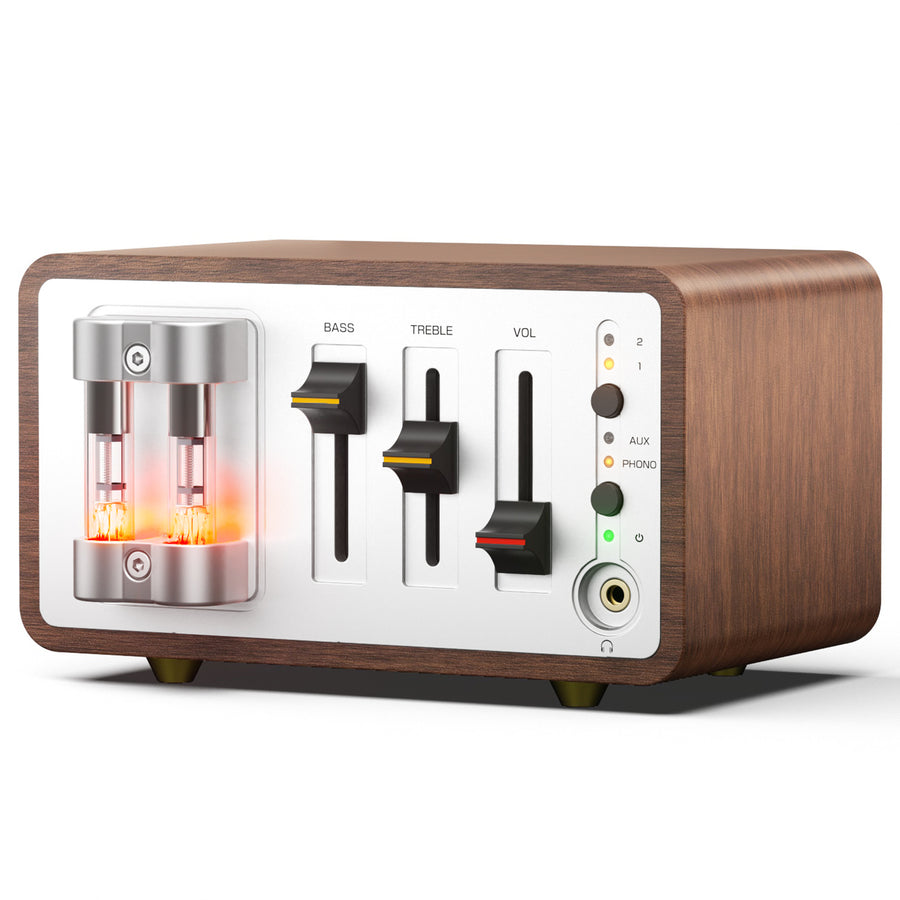
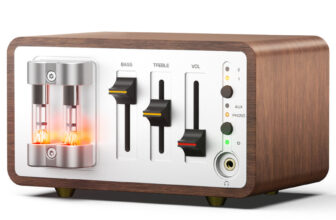
Douk Audio T12 Tube Phono Preamp
A tube phono stage for MM and MC cartridges in a real walnut case, with a line input and a headphone output so it can run a whole small system.
- Handles both MM and MC cartridges
- Real walnut housing, not vinyl wrap
- Line input as well as phono, so it doubles as a preamp
- Headphone amp built in
- Tube phono stages are noisier than good solid-state ones
- The VU meter is styling, not a calibrated instrument

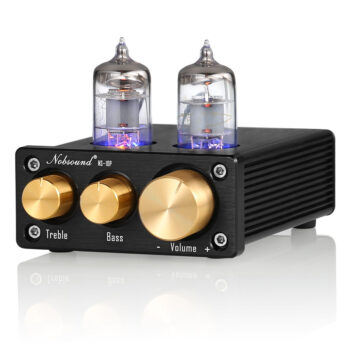
Nobsound NS-10P Tube Preamp
A small tube preamp with treble and bass controls, designed to sit between a source and an amplifier you already own.
- Adds tube character to an existing system
- Treble and bass controls, which most preamps drop
- Small enough for a crowded desk
- Tone controls are a compromise purists dislike
- A preamp alone cannot drive speakers
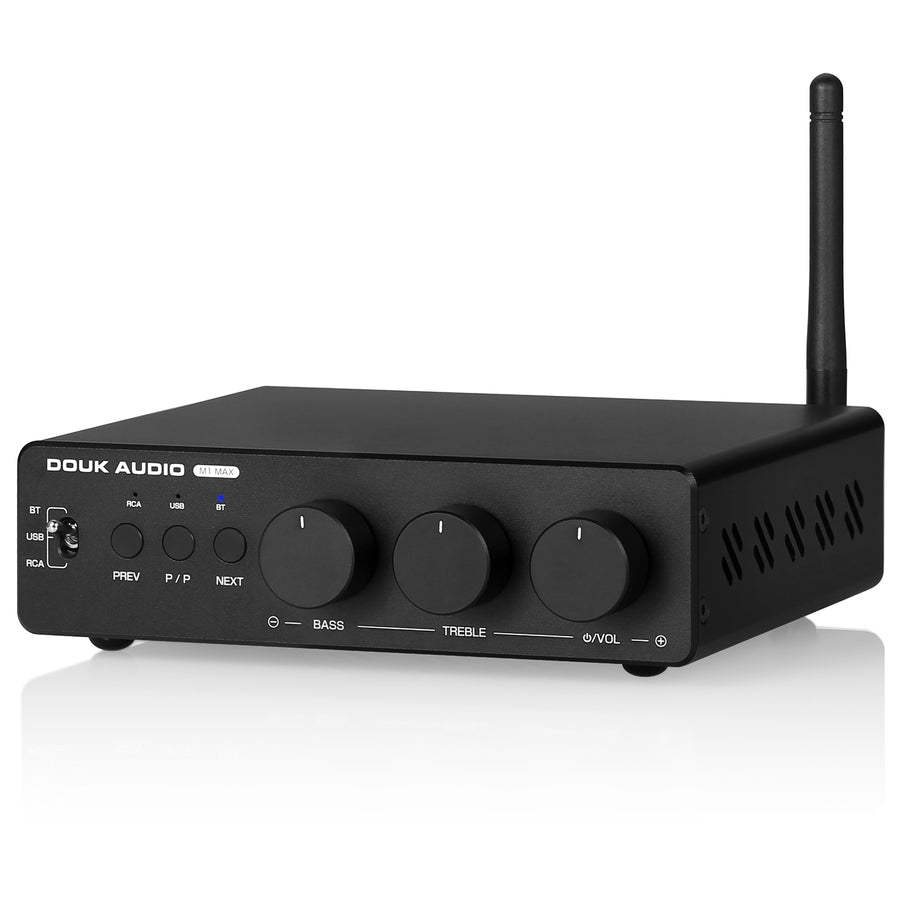
Douk Audio M1 MAX Power Amp
A TPA3255 class-D amplifier with Bluetooth 5.1, RCA and USB stick playback, banana speaker terminals and a 3.5 mm output for a subwoofer.
- Bluetooth 5.1, RCA and USB stick inputs
- Banana plug speaker terminals
- 3.5 mm output for a sub or second amp
- Far more power than the tube amps
- No tube character, which may be the point of shopping here
- Power adapter is a separate option on the listing
Who should avoid it
If you need published measurements before you buy, this is not the brand for you, and no amount of enthusiasm changes that. If you own low-sensitivity speakers in a large room, the small Class A valve amps will disappoint you regardless of how well they are made.
And if what you actually want is for your system to sound better rather than look better, be disciplined about the decorative half of the catalogue. A level meter is a pleasant thing to own once the signal chain is sorted. Bought first, it is the most expensive way to change nothing.
Common questions
Is the build quality any good?
The published materials are real: metal cases across most of the range and a genuine walnut housing on the T12 rather than a printed wrap. We have not handled these units, so we will not claim anything about fit and finish beyond what the specification states.
Where does it ship from?
Listings offer shipping from several regions including the US, UK, EU, Australia and China, and the option you choose changes the delivery time significantly. Check which warehouse the option you select ships from before ordering, particularly if you need it by a date.
Are the tubes genuine or decorative?
Both exist in this catalogue, which is exactly why it is worth reading carefully. On the preamps and integrated amps the valve is in the signal path and doing the work. On the VU meters and spectrum displays the tube is lit and nothing more. The listings are clear about which is which when you look.
Can I use these with a modern streaming setup?
Yes. The DAC handles USB, coaxial and optical, and the M1 MAX takes Bluetooth 5.1 directly. A common arrangement is a streamer or laptop into the DAC, the DAC into a valve preamp, and the preamp into a class-D power amp, which gets you streaming convenience with valve character in the middle.
The verdict
Douk Audio is a genuinely good way to build a small system cheaply, provided you buy the parts that do something. The converter and amplifier chips are the ones a serious design would use, the circuit descriptions are honest, and the phono stage in particular does more than most boxes at any price. The reservations are real too: no published measurements, power supplies that are sometimes an extra, and a large decorative range that is easy to mistake for the useful one. Buy the signal path first. Buy the glow later, if at all.